What's New in InstaCal

InstaCal updates often. Here is everything that has shipped, newest first — told properly, with the App Store bullets one tap away for anyone who just wants the list.

10 releases · 3.0.0 → 3.7.1 · updated September 19, 2026

  1. 3.7.1Latest
    Mac

    Click the menu bar item again to close the panel.

    A Mac update for macOS 27: a second click on the menu bar item closes the panel again, the bottom icon bar is flat again, Calendars gains Hide All, and Quarter can show week numbers.

    Everything in this release

    • On macOS 27, click the menu bar item again to close the panel.
    • Ready for macOS 27: Siri understands your InstaCal events, tasks and reminders. Ask what's on your calendar, when you're free or what's next, then create or change an event just by asking, for one occurrence of a repeating event or every one that follows. The menu bar item and panel take on the new macOS 27 look.
    • New widgets: Agenda List shows your days as one continuous list, with day navigation, event paging and reminder completion right in the widget. On macOS 27, Days Ahead and Up Next + Calendar come in an extra-large portrait size, and Up Next can show your countdowns.
    • Siri and Shortcuts can add and complete tasks, hand your events to other Shortcuts actions, and find events, tasks, reminders, countdowns and Smart Filters in Spotlight.
    • Tasks: a task manager built into your calendar, with lists, tags, checklists and progress, kept separate from Apple Reminders. Capture a task in plain language, keep a finish-by deadline apart from the time you plan to work on it, and find room for it within your working hours.
    • Connect Google Tasks, Microsoft To Do and Todoist, each synced directly beside your personal task library. Search, sort and filter tasks and reminders by date, priority or completion.
    • Lock InstaCal behind Touch ID or your login password, with a lock-after delay; while locked, the menu bar shows only the date. Mark calendars private to keep them hidden until you show them with Touch ID, with quiet or detail-free alerts.
    • Give a countdown a photo, your own or one generated from a description (even with you in it), and see it as a full-size poster, in photo-row widgets, or as its own menu bar item.
    • See the year as a wall planner, twelve month rows under one weekday header, and put the current month first, middle or last in Quarter, with separate heat maps for each.
    • Choose up to two detail lines for events, tasks, reminders and countdowns, shown in lists and widgets and synced across your devices.
    • Block on Calendar puts a private "Busy" copy of any event on another calendar, and Remove Blocking takes it back.
    • Reorder accounts, calendars and reminder lists, and arrange the calendars inside a Calendar Set.
    • Call a phone number from an event in the app you choose: FaceTime, WhatsApp, Google Voice or Zoom Phone. Export events to CSV, and import any .ics file by double-clicking it, even one containing broken events.
    • Give Calendar, Reminders and Tasks their own menu bar items, choose whether + creates an event, a reminder or a task, and ignore a repeating invitation series without replying.
  2. MaciOS

    Ask about your day. See the days ahead.

    Try Siri schedule answers and calendar changes on supported systems, see tomorrow in spare XL agenda space, and search your entries from Spotlight. Private calendars and App Lock protect what stays hidden.

    Ask about your dayMaciOS

    Ask for today's schedule, the next event or available time on enabled calendars. Ongoing and all-day events count, mirrored copies do not repeat, and an incomplete refresh is explained. On supported OS 27 systems, try creating and changing an event through Siri. Physical-device conversation routing remains a beta check; private calendars and App Lock protect both answers and edits.

    App-wide Spotlight search on iPhone; also available on Mac.

    More days in the same agendaMaciOS

    Up Next + Calendar uses spare XL height for tomorrow and later dates while keeping the selected day first. Days Ahead and Up Next + Calendar also have extra-large portrait layouts where the system offers them. Sample-data view renders have been checked; gallery placement and Home Screen captures remain pending.
    Up Next + Calendar uses spare XL space for later dates.

    Find it from SpotlightMaciOS

    Search across what you keep in InstaCal. Events, personal tasks, Apple Reminders, connected-service tasks and countdowns join saved templates, calendars, lists, Calendar Sets and Smart Filters. Notes, tags, checklist text, section names and attachment filenames help find their parent task or list. Open a result to reach its matching content.

    Search includes every event loaded by InstaCal, without the old date window or item limit. Completed personal tasks and archived lists remain searchable. Event results use the system's date and time presentation with calendar metadata, removing the repeated fixed-date line.

    On iOS 27 and macOS 27, try asking Siri about tasks, reminders and events. This beta supplies structured content; live contextual answers and final system-search presentation still need device verification. App Lock clears all search categories, and private content stays out of system search even while revealed inside InstaCal.

    App-wide Spotlight search on iPhone; also available on Mac.

    Your tasks, your calendarMaciOS

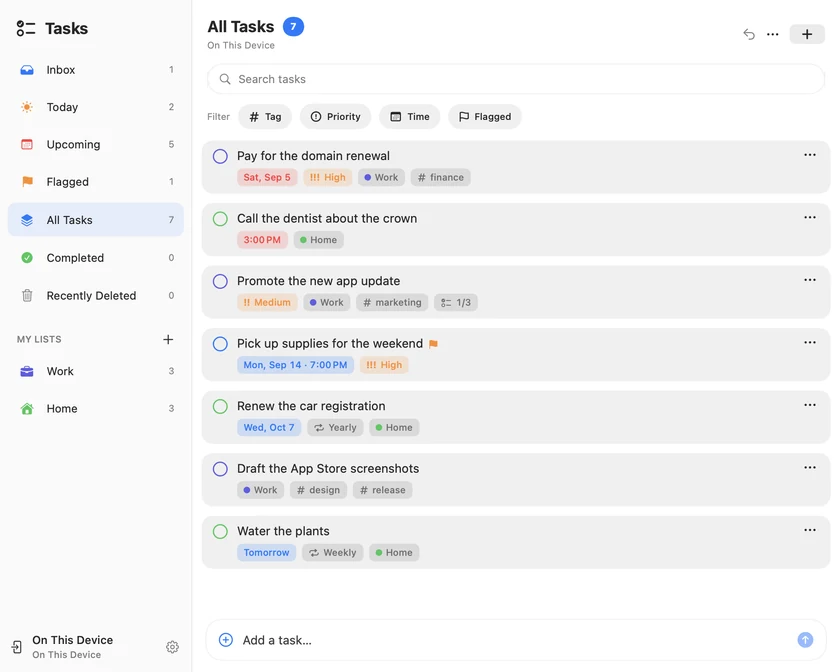
    Give your own tasks a place beside your calendar. Keep a quick thought in Inbox, or organize a longer list with sections, tags, flags and checklists. Today and Upcoming bring planned work and approaching deadlines together; Completed keeps the progress you have made.

    Tasks has its own library, separate from Apple Reminders, and needs no InstaCal account. On Mac, use the panel, calendar sidebar or full Tasks window shown here. On iPhone and iPad, open Tasks from the utility toolbar above your current calendar view.

    The current TestFlight builds use On This Device storage. Tasks labels are translated in every supported language; iCloud task sync remains unavailable while production checks are completed. Google Tasks shows Coming soon while Google reviews access. Microsoft To Do and Todoist connect separately, and Google Calendar remains available. Deleted tasks can be restored for 30 days, and an exported task archive provides a restorable backup.

    InstaCal's Tasks window on Mac with Work and Home lists and task cards showing dates, priorities, tags and checklist progress
    Tasks on Mac: your own lists and checklists beside the calendar.

    Make room to do themMaciOS

    A plan and a deadline answer different questions. Choose when you want to work, then set a separate finish-by deadline. Moving the planned time keeps that deadline in place.

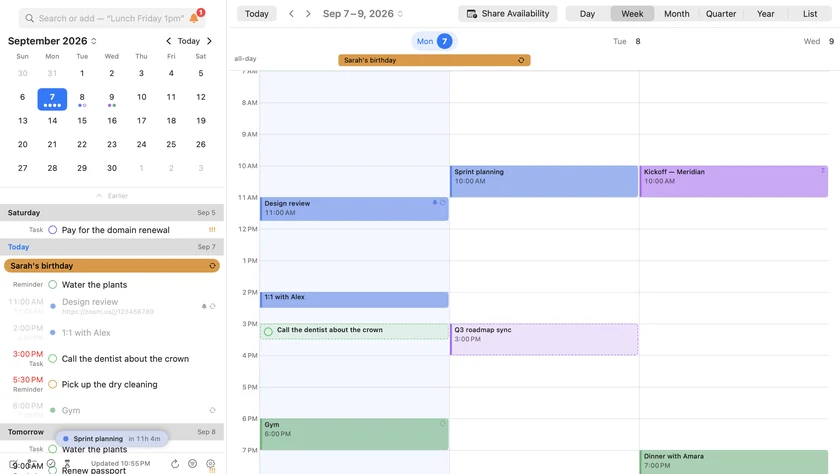
    Timed tasks appear as blocks in Day and Week, beside your meetings. Drag a task onto the time grid, or use Schedule in Free Time to find a gap within your working hours. Auto-Schedule looks ahead through the coming week and respects each task's deadline. Add an alert separately when you want a notification.

    InstaCal's Week view on Mac showing a green dentist task block at 3 PM beside sample meetings
    Week on Mac: give a task time alongside your meetings.

    Capture the thoughtMaciOS

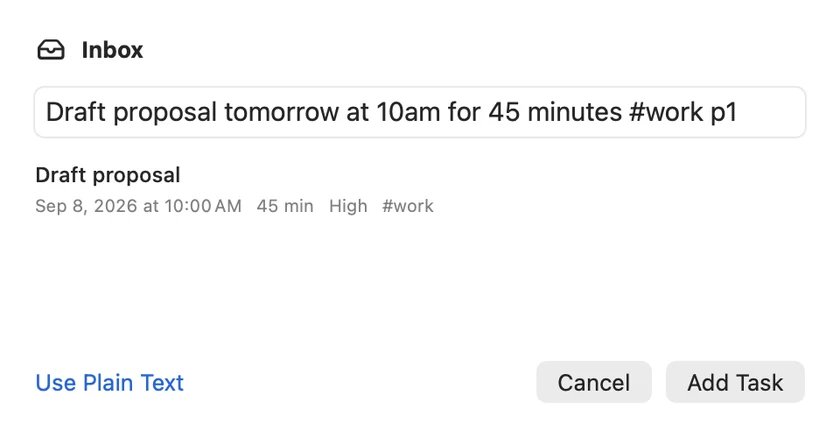
    Type the task while it is still on your mind. Quick entry recognizes a date, time, duration, #tags and p1/p2/p3 priority on your device. The preview shows what will be saved; Use Plain Text keeps your words exactly as typed.

    On Mac, File ▸ New Task opens the floating entry panel shown here. Assign an optional global New Task shortcut in Settings to open it while using another app. On iPhone and iPad, enter a task in the Tasks sheet and check its preview before adding it.

    InstaCal's floating task entry panel on Mac with a proposal draft recognized for tomorrow at 10 AM for 45 minutes, high priority and the work tag
    Quick entry on Mac: review the recognized details before adding the task.

    A quarter that looks backMaciOS

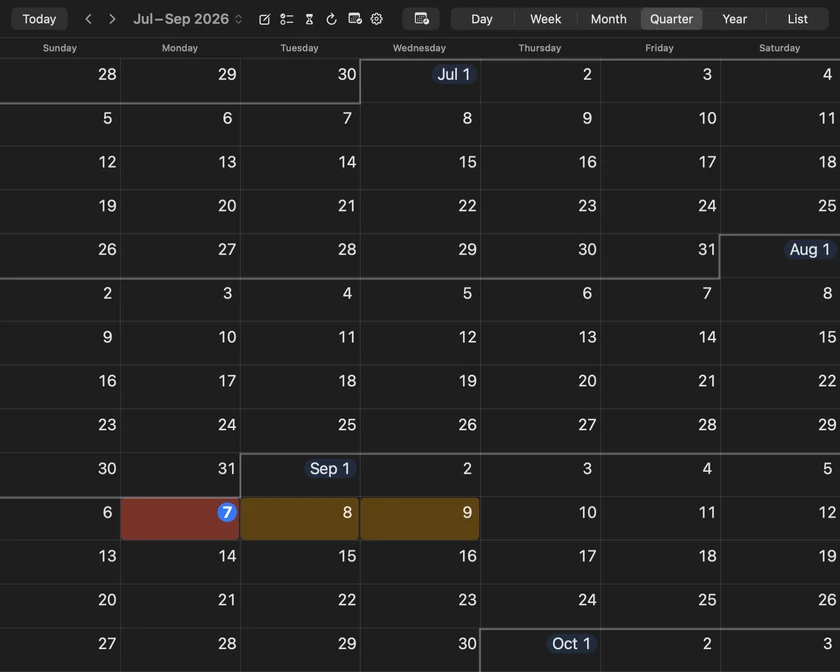
    Put the current month where it helps you plan. Quarterly View now lets you choose First, Middle or Last. Choose Last and September sits at the end of July–September, so the two months behind you stay in view. Today and Go to Date restore that position, while the arrows still move through three months at a time.

    On Mac, open Settings ▸ Appearance ▸ Quarterly View. On iPhone and iPad, open Settings ▸ Appearance ▸ Quarterly View. The choice syncs across your devices.

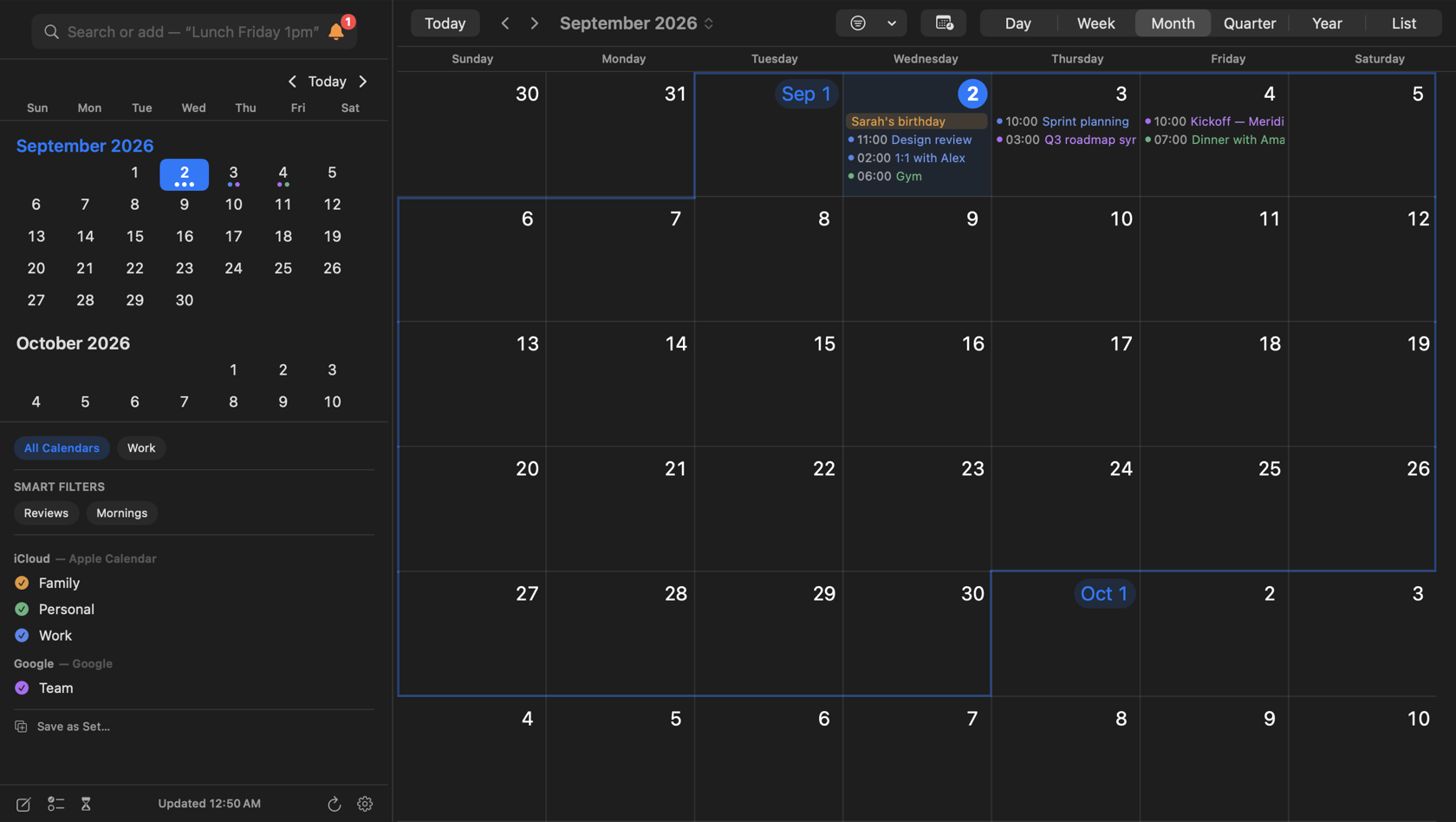
    InstaCal's Quarter view on Mac showing July through September 2026, with September last, complete month boundaries and heat colors on busy days around September 7
    Quarter on Mac: September last, with July and August still in view. Busy days use heat colors.

    Heat maps, chosen per viewMaciOS

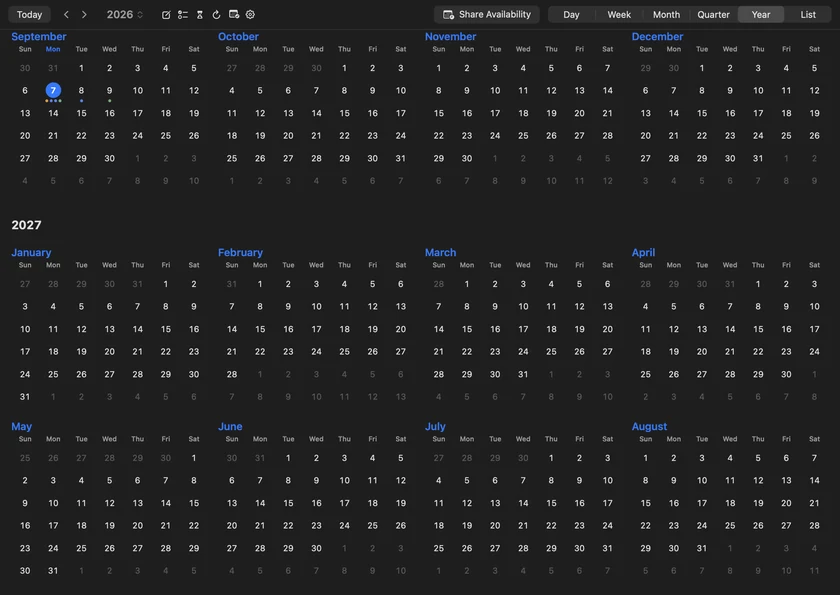
    Year and Quarter keep separate heat-map choices. The Mac screenshots here use heat colors in Quarter and ordinary event markers in Year, with the same sample calendars. Choose whichever combination makes each view easier to read.

    On Mac, View ▸ Heat Map gives Quarter and Year their own checkmarks, so you can switch either without opening Settings. You can also set each heat map in Appearance on Mac or Appearance on iPhone and iPad; those choices sync across your devices.

    InstaCal's Year view on Mac with colored event dots under dates in September and no heat-map shading
    Year on Mac keeps event markers, using the same calendars as the Quarter view above.

    Plus 21 smaller changes — fixes, tidy-ups and one-line wins that didn't need a paragraph. See every line →

    Everything in this release

    • Ready for macOS 27: Siri understands your InstaCal events, tasks and reminders. Ask what's on your calendar, when you're free or what's next, then create or change an event just by asking, for one occurrence of a repeating event or every one that follows. The menu bar item and panel take on the new macOS 27 look.Mac
    • New widgets: Agenda List shows your days as one continuous list, with day navigation, event paging and reminder completion right in the widget. On macOS 27, Days Ahead and Up Next + Calendar come in an extra-large portrait size, and Up Next can show your countdowns.Mac
    • Siri and Shortcuts can add and complete tasks, hand your events to other Shortcuts actions, and find events, tasks, reminders, countdowns and Smart Filters in Spotlight.Mac
    • Tasks: a task manager built into your calendar, with lists, tags, checklists and progress, kept separate from Apple Reminders. Capture a task in plain language, keep a finish-by deadline apart from the time you plan to work on it, and find room for it within your working hours.
    • Connect Google Tasks, Microsoft To Do and Todoist, each synced directly beside your personal task library. Search, sort and filter tasks and reminders by date, priority or completion.
    • Lock InstaCal behind Touch ID or your login password, with a lock-after delay; while locked, the menu bar shows only the date. Mark calendars private to keep them hidden until you show them with Touch ID, with quiet or detail-free alerts.Mac
    • Give a countdown a photo, your own or one generated from a description (even with you in it), and see it as a full-size poster, in photo-row widgets, or as its own menu bar item.Mac
    • See the year as a wall planner, twelve month rows under one weekday header, and put the current month first, middle or last in Quarter, with separate heat maps for each.Mac
    • Choose up to two detail lines for events, tasks, reminders and countdowns, shown in lists and widgets and synced across your devices.
    • Block on Calendar puts a private "Busy" copy of any event on another calendar, and Remove Blocking takes it back.
    • Reorder accounts, calendars and reminder lists, and arrange the calendars inside a Calendar Set.
    • Call a phone number from an event in the app you choose: FaceTime, WhatsApp, Google Voice or Zoom Phone. Export events to CSV, and import any .ics file by double-clicking it, even one containing broken events.Mac
    • Give Calendar, Reminders and Tasks their own menu bar items, choose whether + creates an event, a reminder or a task, and ignore a repeating invitation series without replying.Mac
    • Ready for iOS 27: Siri understands your InstaCal events, tasks and reminders. Ask what's on your calendar, when you're free or what's next, then create or change an event just by asking, for one occurrence of a repeating event or every one that follows.iOS
    • New widgets: Agenda List shows your days as one continuous list, with day navigation, event paging and reminder completion right on your Home Screen. On iOS 27, Days Ahead and Up Next + Calendar add an extra-large portrait size where your device offers it, XL agendas fill spare room with the days ahead, and Up Next can show your countdowns.iOS
    • Say "Remind me in InstaCal" to capture a reminder in plain language. Siri and Shortcuts can also add and complete tasks, hand your events to other Shortcuts actions, and find events, tasks, reminders, countdowns and Smart Filters in Search.iOS
    • Lock InstaCal behind Face ID or Touch ID, with your passcode as the fallback and a lock-after delay; the app switcher shows a cover, not your events. Mark calendars private to keep them hidden until you show them with Face ID, with quiet or detail-free alerts.iOS
    • Give a countdown a photo, your own or one generated from a description (even with you in it). Tap it for a full-screen poster that counts down to the second, and see it in photo-row widgets.iOS
    • See the year as a wall planner, twelve month rows under one weekday header (turn the phone sideways for the whole year), and put the current month first, middle or last in Quarter, with separate heat maps for each.iOS
    • Call a phone number from an event in the app you choose: Phone, FaceTime Audio, WhatsApp, Google Voice or Zoom Phone. Export events to CSV, and open any .ics file from Mail or Files, even one containing broken events.iOS
    • A Date complication on Apple Watch shows the weekday and day and opens InstaCal with a tap. Choose whether + creates an event, a reminder or a task, and ignore a repeating invitation series without replying.iOS
  3. MaciOS

    Direct accounts, and a conflict that says what it costs

    iCloud, Fastmail and any CalDAV server connect inside the app, Zoom meetings come from the event editor, an overlapping event gets a card that prices the clash, and every view scrolls without end — on the Mac, iPhone and iPad.

    A conflict that says what it costsMac

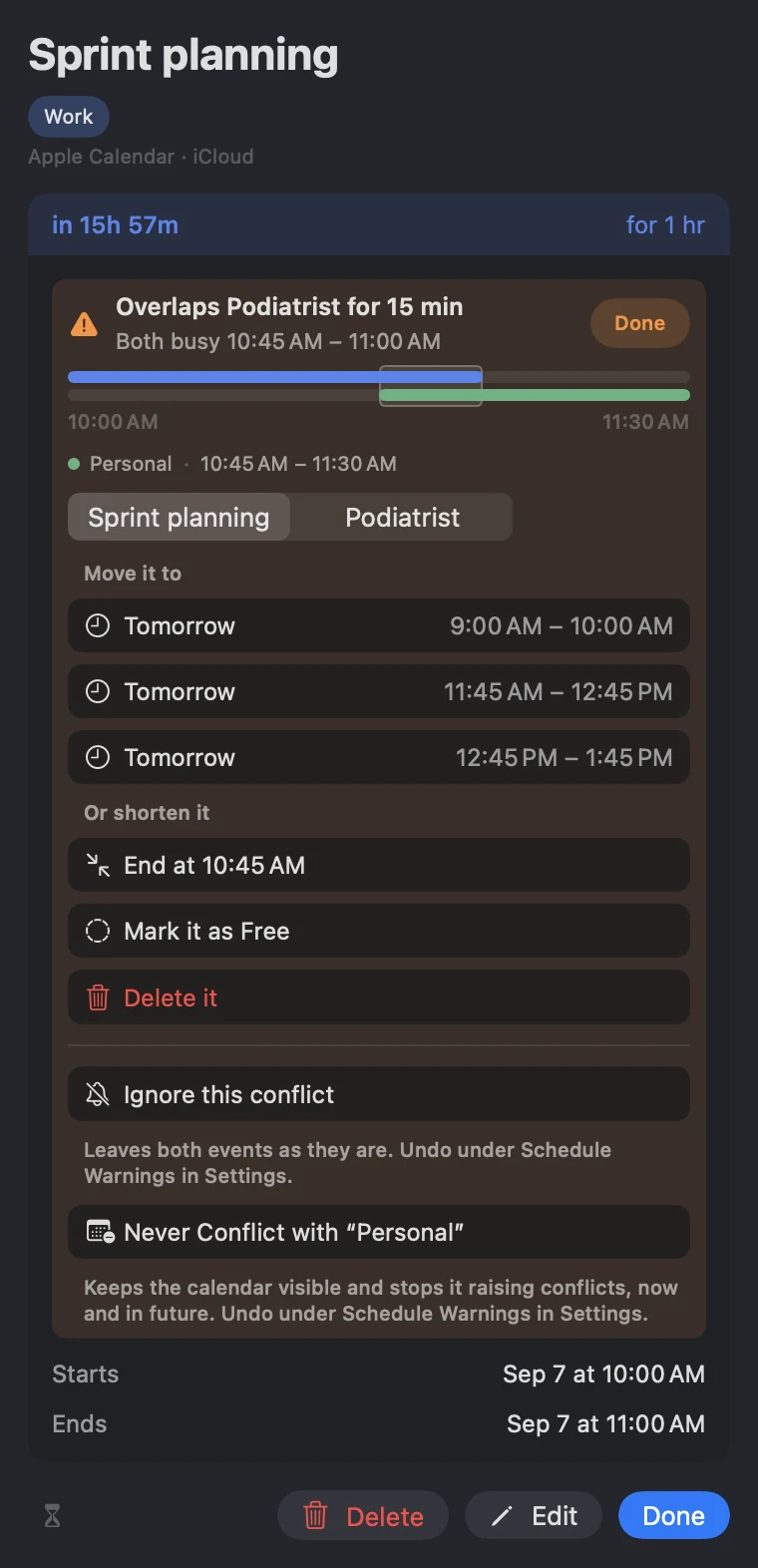
    An overlapping event now gets a card of its own, and that card does the arithmetic for you. It names the other event and how much of your time it takes — "Overlaps Podiatrist for 15 min", or its own sentence when one event swallows the other whole — and under that, the exact stretch in dispute: "Both busy 10:45 AM – 11:00 AM". A timeline draws both events as bars on one shared axis, with your event's bar in the same place on every conflict row, so two or three collisions can be read against each other.

    Clicking anywhere on the card opens the ways out: open times to move to, found against the same calendars that called this busy; ending the event where the other one starts; marking it Free; or leaving both alone. A calendar you can see but cannot act on — a shared family calendar, a holiday feed — can be kept out of conflict checking entirely, from the conflict itself.

    InstaCal's event card on Mac with a conflict card reading “Overlaps Podiatrist for 15 min” over “Both busy 10:45 AM – 11:00 AM”, both events drawn as bars on one timeline, and the ways out open beneath it — three open times to move to, ending it early, marking it free, deleting it, ignoring the conflict, or never conflicting with the Personal calendar
    The overlap, the minutes it costs, and the ways out of it.

    Every way a calendar can connect, in one listMac

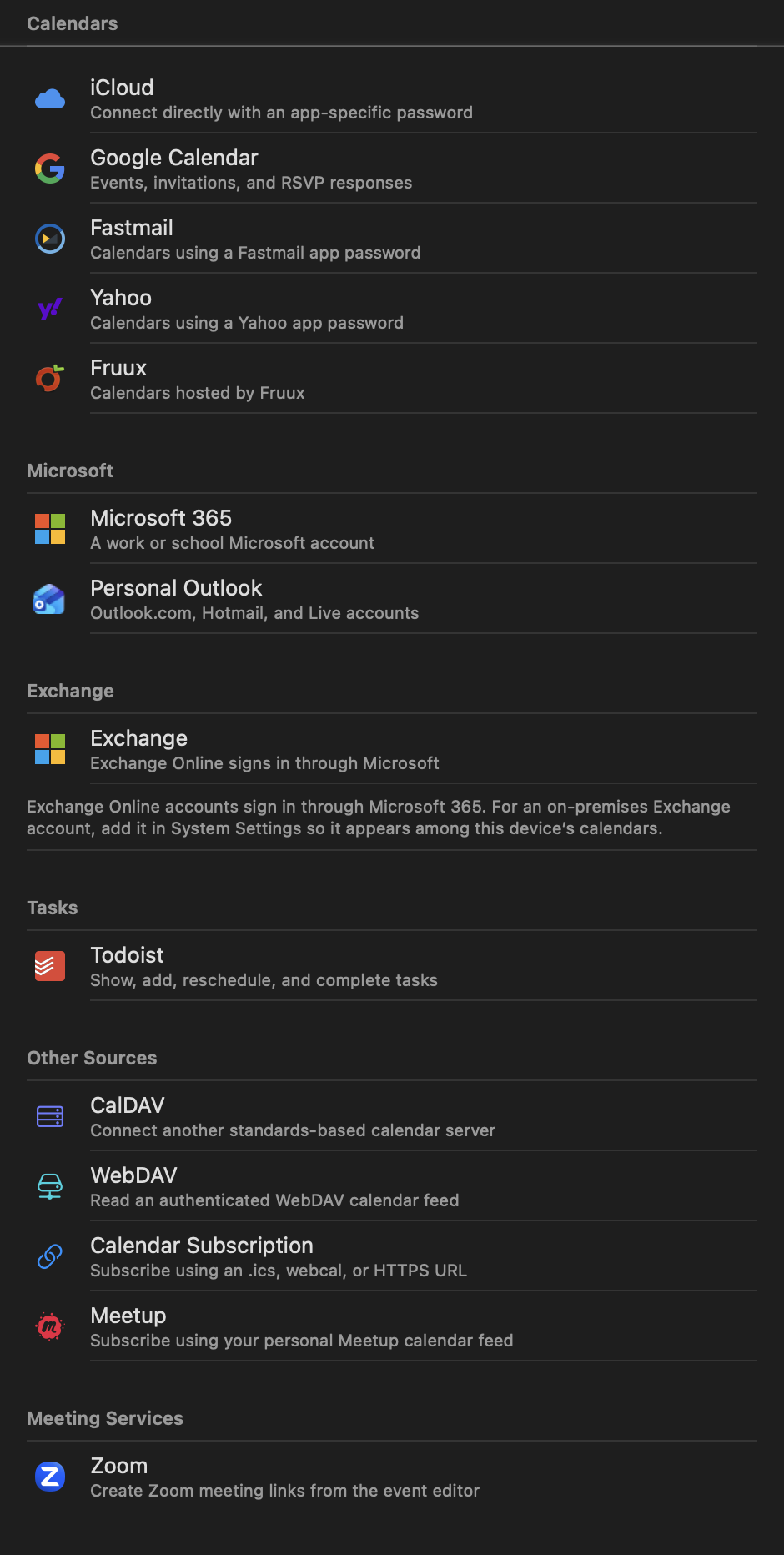
    Settings ▸ Accounts ▸ Add Direct Account… lists every kind of calendar InstaCal can connect to on its own, without going through System Settings first. iCloud, Fastmail, Yahoo and Fruux arrive with their server address already filled in and a link to the page where that provider issues an app-specific password. Google, Microsoft 365, Personal Outlook and Exchange Online sign in with their own consent screens.

    Any other standards-based server goes in under CalDAV, WebDAV and Calendar Subscription read a feed, Meetup subscribes to your own calendar there, Todoist brings its tasks alongside your reminders, and Zoom lets the event editor mint a meeting on any calendar.

    The Add Account list on Mac grouped as Calendars with iCloud, Google Calendar, Fastmail, Yahoo and Fruux; Microsoft with Microsoft 365 and Personal Outlook; Exchange; Tasks with Todoist; Other Sources with CalDAV, WebDAV, Calendar Subscription and Meetup; and Meeting Services with Zoom
    Fourteen ways in, none of them through System Settings.

    A sidebar that holds what you wantMac

    The calendar window's leading column is now a mode, chosen under Settings ▸ Appearance ▸ Calendar ▸ Sidebar or View ▸ Sidebar. Agenda keeps the panel's day list beside the calendar as before. Months trades it for a scrolling run of months, so a whole quarter is a glance away. Calendars keeps the mini month with the calendar list pinned open beneath it, and Months and Calendars splits the column between the two.

    Hidden removes the column altogether, and the footer's buttons — New Event, Reminders, Countdowns, Refresh, Calendars and Settings — move up beside the month title so nothing goes with it.

    InstaCal's calendar window on Mac in Month view, with the sidebar showing a scrolling run of months above the calendar list
    Months above, calendars below — or either alone, or neither.

    The same catalog on iPhoneiOS

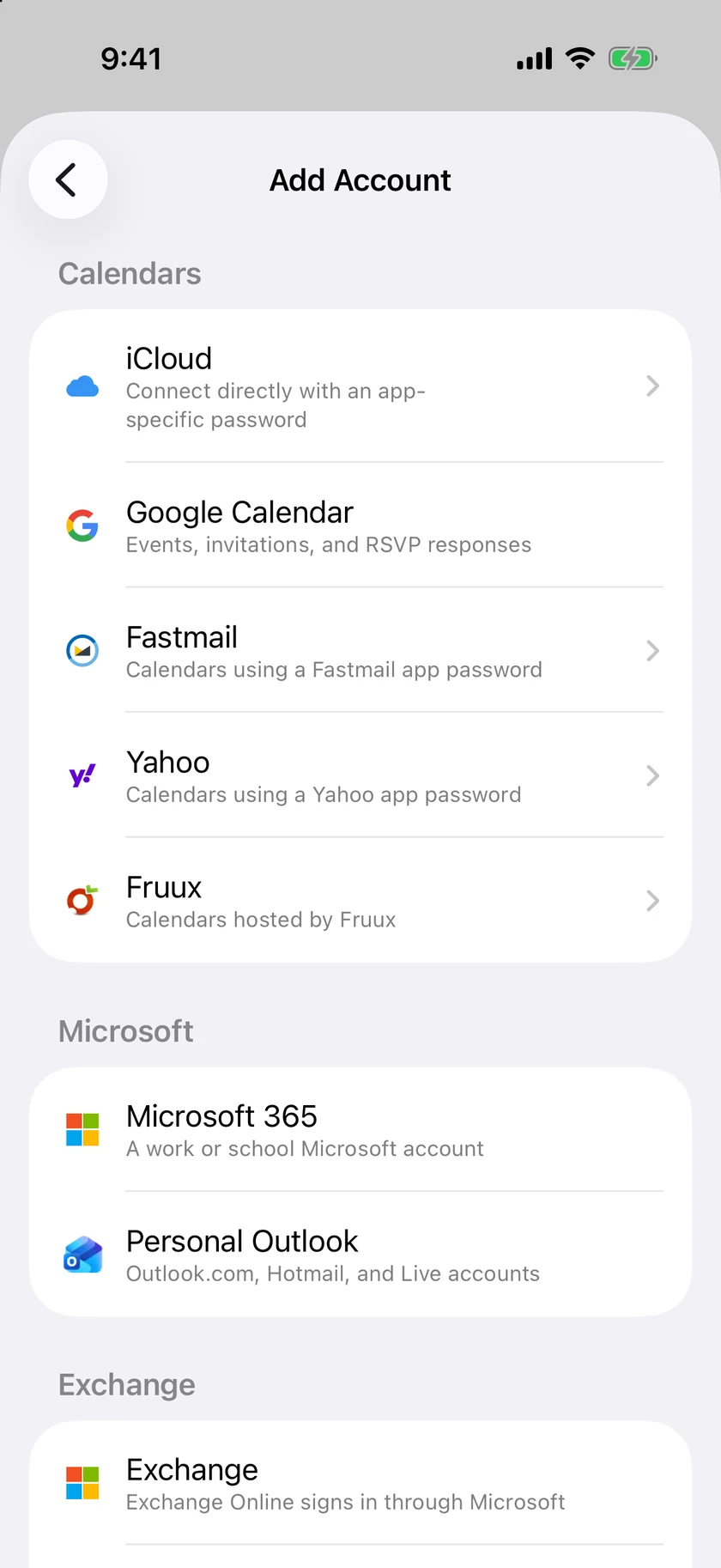
    Settings ▸ Accounts ▸ Add Direct Account… on iPhone offers the same providers, grouped by kind: Calendars, Microsoft, Exchange, Tasks, Other Sources and Meeting Services. iCloud, Fastmail, Yahoo and Fruux come with their server address filled in and a link to where each issues an app-specific password; Google and Microsoft sign in with their own screens.

    Direct connections sync inside InstaCal, and the credentials stay on the phone.

    The Add Account screen on iPhone showing the Calendars group with iCloud, Google Calendar, Fastmail, Yahoo and Fruux, the Microsoft group with Microsoft 365 and Personal Outlook, and the start of the Exchange group
    Direct connections, credentials kept on the phone.

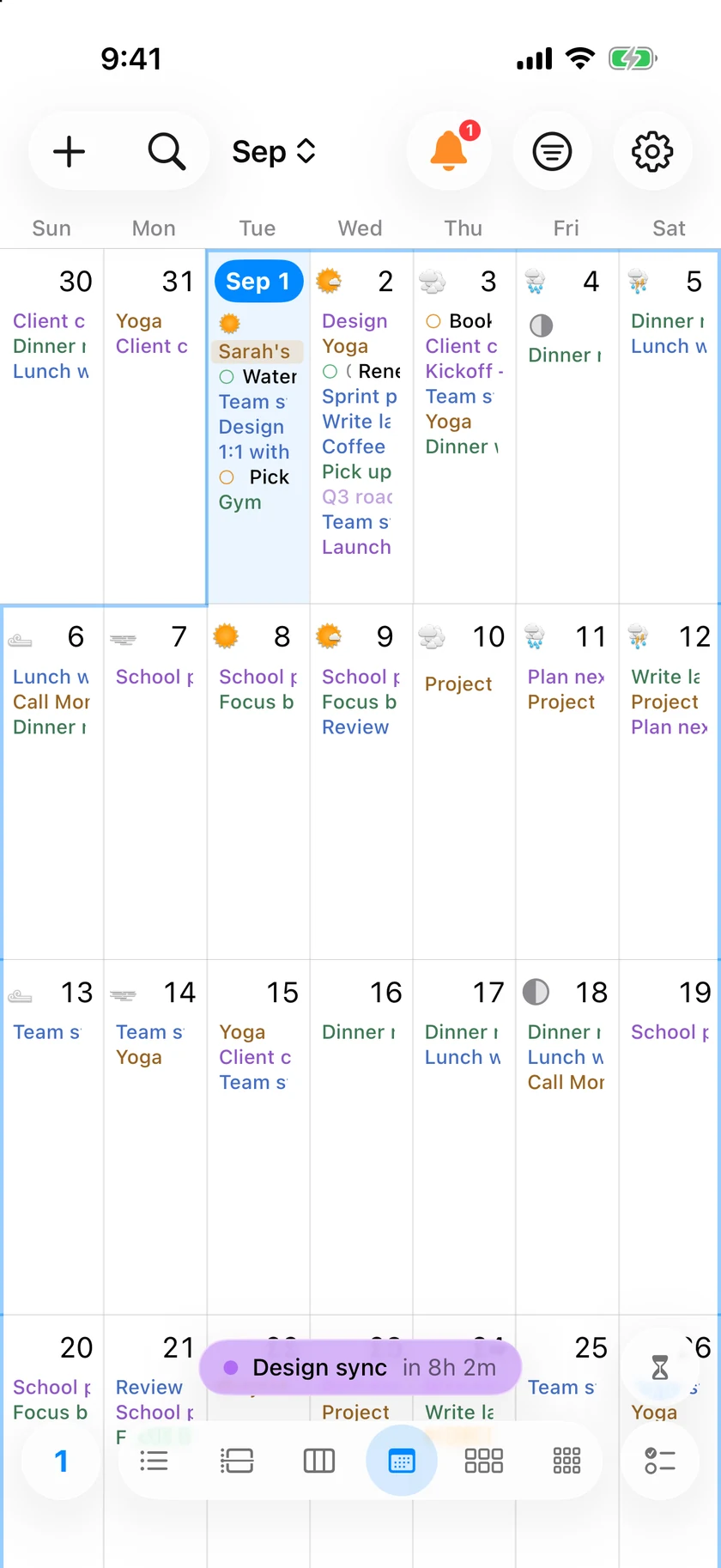
    Fewer weeks, taller daysiOS

    Month view fits as few as two weeks on screen or as many as six. Set Weeks Visible under Settings ▸ Appearance ▸ Month View, or pinch the grid itself when the pinch gesture is set to Density.

    With three weeks showing, each day is tall enough for several event titles before the overflow count takes over, and the grid still scrolls as one continuous run of weeks with the selected day's outline riding along.
    InstaCal's Month view on iPhone with Weeks Visible set to three, so the weeks of August 30, September 6 and September 13 fill the screen and Tuesday September 1 lists six event titles including Sarah's birthday, Team standup and Design review
    Three weeks on screen, and every day has room to talk.

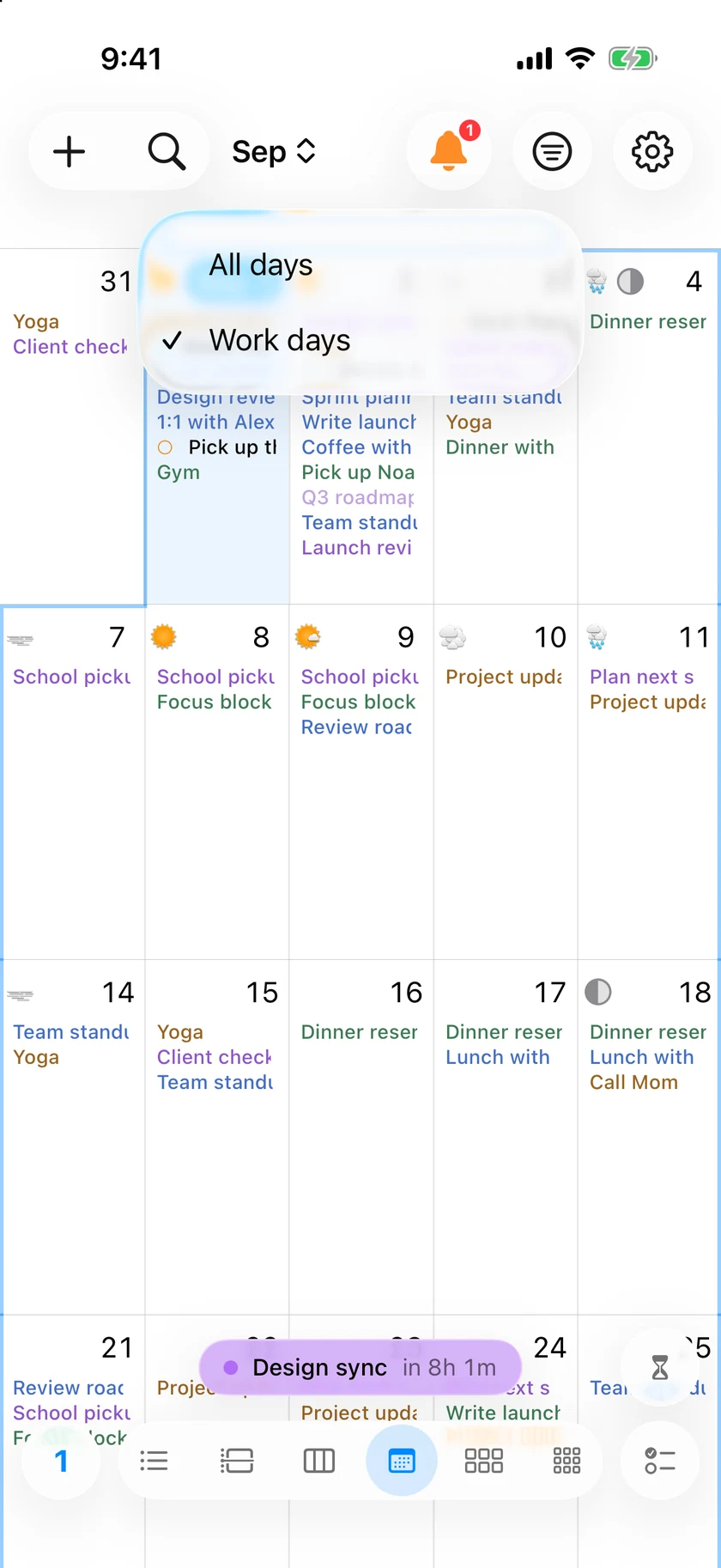
    Work days onlyiOS

    Tap the weekday header in Month view and choose Work days, and the weekend columns step aside. Monday through Friday take the whole width, so every working day gets more room for its titles.

    The same switch lives under Settings ▸ Appearance ▸ Month View ▸ Days Shown, and All days brings Saturday and Sunday back.

    InstaCal's Month view on iPhone showing only Monday through Friday columns, with the weekday header's menu open offering All days and Work days and Work days checked
    Tap the header, drop the weekend.

    Plus 23 smaller changes — fixes, tidy-ups and one-line wins that didn't need a paragraph. See every line →

    Everything in this release

    • Browsing is instant, years deep. Your calendars keep a local mirror of about six years of events and sync only what changes, so any month — 2024 or 2029 — paints the moment you arrive, online or offMac
    • Every view scrolls like a native calendar. Month is one continuous run of weeks, Quarter a grid of thirteen weeks with the month boundaries ruled as seams, Year a run of month rows four across, and Week slides sideways through your days without end — two to seven at a time, three by default, with hours that stretch to fill a tall windowMac
    • Calendars connect directly, without going through System Settings first. iCloud, Fastmail, Yahoo and Fruux arrive with their server address filled in and a link to where that provider issues an app-specific password; any other standards-based server goes in under CalDAV. Subscribe to a webcal, .ics or HTTPS feed with an optional password and a re-check interval of your choosing, and Todoist tasks sit alongside your reminders — added, rescheduled, completed and reopened with their priorities intactMac
    • Connect Zoom and the event editor will mint a Zoom meeting on any calendar, not only the ones whose provider offers Meet or Teams. The meeting belongs to the event, so it travels with it between calendars and goes away when the event does
    • A conflict tells you what it costs. An overlapping event gets a card naming the other event, the exact minutes in dispute, and a timeline drawing both on one axis. Click it for the ways out — an open time to move to, shortening it, marking it free. An event that only falls outside your working hours reads as a note rather than an alarm, and a calendar you can see but cannot act on can stay out of conflict checking entirelyMac
    • Before a change touches an event's guests, InstaCal asks whether to email them — the same Send / Don't Send choice Google Calendar offers — for edits, reschedules, moves, deletes and new invitationsMac
    • The calendar window's sidebar is a mode. Settings › Calendar › Sidebar chooses Agenda, a scrolling run of Months, the Calendars list, both together, or Hidden — and with no column, the toolbar moves up beside the month title. The window opens in a fraction of a second, views re-flow live while you drag its corner, and Settings switches panes instantlyMac
    • Month view can show work days only — the weekend columns step aside so the working week gets the whole width, switched in Settings or by clicking the weekday header right on the grid. Month opens on the current week, and a long title ends on a whole letter instead of being chopped through oneMac
    • Google Calendar, Microsoft 365 and Outlook, and Apple's Calendar are each handled reference by reference. Outlook recurring events show their titles and Outlook all-day events land on the right day; Google's typed events — birthdays, Gmail flights, focus time — save where they used to fail and explain the rule where they can't; an Apple Calendar edit keeps its location alarms and custom sounds; and a calendar two Google accounts share appears under both, with the account that can write to it owning your edits
    • Moving an event to another calendar sticks: it re-files on the spot, stays put through a refresh, and a move made elsewhere is noticed and repaired within a refresh. Reminders made in Siri or the Reminders app appear as soon as InstaCal notices themMac
    • When InstaCal can't see your reminders or your calendar, the list says so — with a Set Up… button that asks for access, or a pointer to the right pane of System Settings — instead of reading as an empty day. And when the menu bar item isn't on screen, dropped past the camera housing or hidden by Ice or Bartender, Settings › Menu Bar says which, and relaunching the app opens the panel with a button to fix itMac
    • Ask for what's missing from inside the app. Settings › General › Request a Feature takes a type, a one-line summary, details and an optional screenshot, and lands with the people who build InstaCal — no mail client, no accountMac
    • The iPad has the whole toolkit: a + for events and reminders, the search and quick-add field in the sidebar — type "Lunch Friday 1pm" and the card fills itself in — the calendar filter, a Reminders toggle, a long press on any empty hour that opens the full editor, Command-R to refresh, and event details, day lists and reminder editors that open as proper sheetsiOS
    • Reminders are a hold away on the iPhone: hold the + for Add Event or Add Reminder, and over the Reminders list a plain tap adds a reminder. Refresh is a command of its own under Settings › Button Layout, ready to drag onto any bariOS
    • Browsing is instant, years deep. Your calendars keep a local mirror of about six years of events and sync only what changes, so any month — 2024 or 2029 — paints the moment you arrive, online or off. The agenda renders two years ahead, so a fling carries as far as you throw itiOS
    • The weekly strip swipes endlessly in either direction and shows two to seven days at a time — three by default — with hours that stretch to fill a taller screen. A busy week opens and swipes without stutter, the all-day strip shows every all-day event instead of stopping at four, and Quarter is one continuous grid of thirteen weeksiOS
    • Month view is yours to shape. Fit as few as two weeks on screen or as many as six, from Appearance or by pinching the grid; show work days only, so the working week gets the full width; open on the current week or the top of the month; and Today is a home button — one press lands on today's week, a second opens today's cardiOS
    • Calendars connect directly, without going through the Settings app first. iCloud, Fastmail, Yahoo and Fruux arrive with their server address filled in and a link to where that provider issues an app-specific password; any other standards-based server goes in under CalDAV. Subscribe to a webcal, .ics or HTTPS feed with an optional password and a re-check interval of your choosing, and Todoist tasks sit alongside your reminders — ticking one off in a widget completes it in TodoistiOS
    • Before a change touches an event's guests, InstaCal asks whether to email them — the same Send / Don't Send choice Google Calendar offers — for edits, reschedules, moves, deletes and new invitations. The Watch and Shortcuts keep sending automaticallyiOS
    • Moving an event to another calendar sticks: it re-files on the spot, stays put through a refresh, and a move made on the web or your Mac is noticed and repaired within a refresh. Reminders made in Siri or the Reminders app appear when you return to InstaCaliOS
    • When InstaCal can't see your reminders or your calendar, the list says so — with a Set Up… button that asks for access, or a pointer to the right page of the Settings app — instead of reading as an empty dayiOS
    • Fixed: returning from the background no longer leaves the agenda, Month and Settings stuck until you force-quit. The agenda tracks your finger faithfully — background refreshes and history loads can no longer freeze the scroll or yank the list awayiOS
    • Ask for what's missing from inside the app. Settings › About › Request a Feature takes a type, a one-line summary, details and an optional screenshot from Photos, and lands with the people who build InstaCal — no mail client, no accountiOS
  4. MaciOS

    Week on Week, and paging on iPad

    A new Week on Week view lines the same weekday up across seven weeks on the Mac, Week and Day page under a swipe on iPad, and Google and Outlook sync now rides out a rate limit instead of failing on first touch.

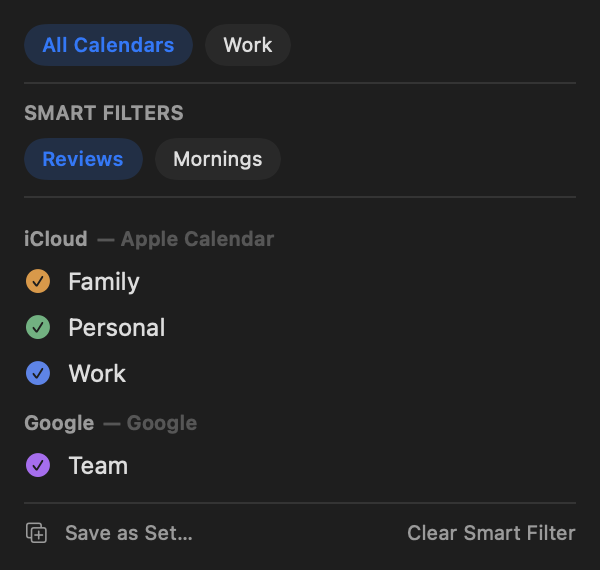
    The filter you are in, named where the calendars areMac

    Every Smart Filter waits in the panel's calendars popover, and the one that is on is marked. A filter bundles a search, a set of calendars, rules and a view into something you can return to: a rule can require a word or exclude one, match the hour an event starts or the day of the week, and the rules combine with All or Any.

    The same filters sit in the View menu with a shortcut key of your own, so a workspace is one keystroke away, and Clear Smart Filter puts the panel back the way it was.

    The menu bar panel's calendars popover on Mac with a Work calendar set, two Smart Filters named Reviews and Mornings with Reviews selected, the iCloud and Google calendar lists, and Save as Set and Clear Smart Filter at the foot
    Two filters saved, one on — and the popover says which.

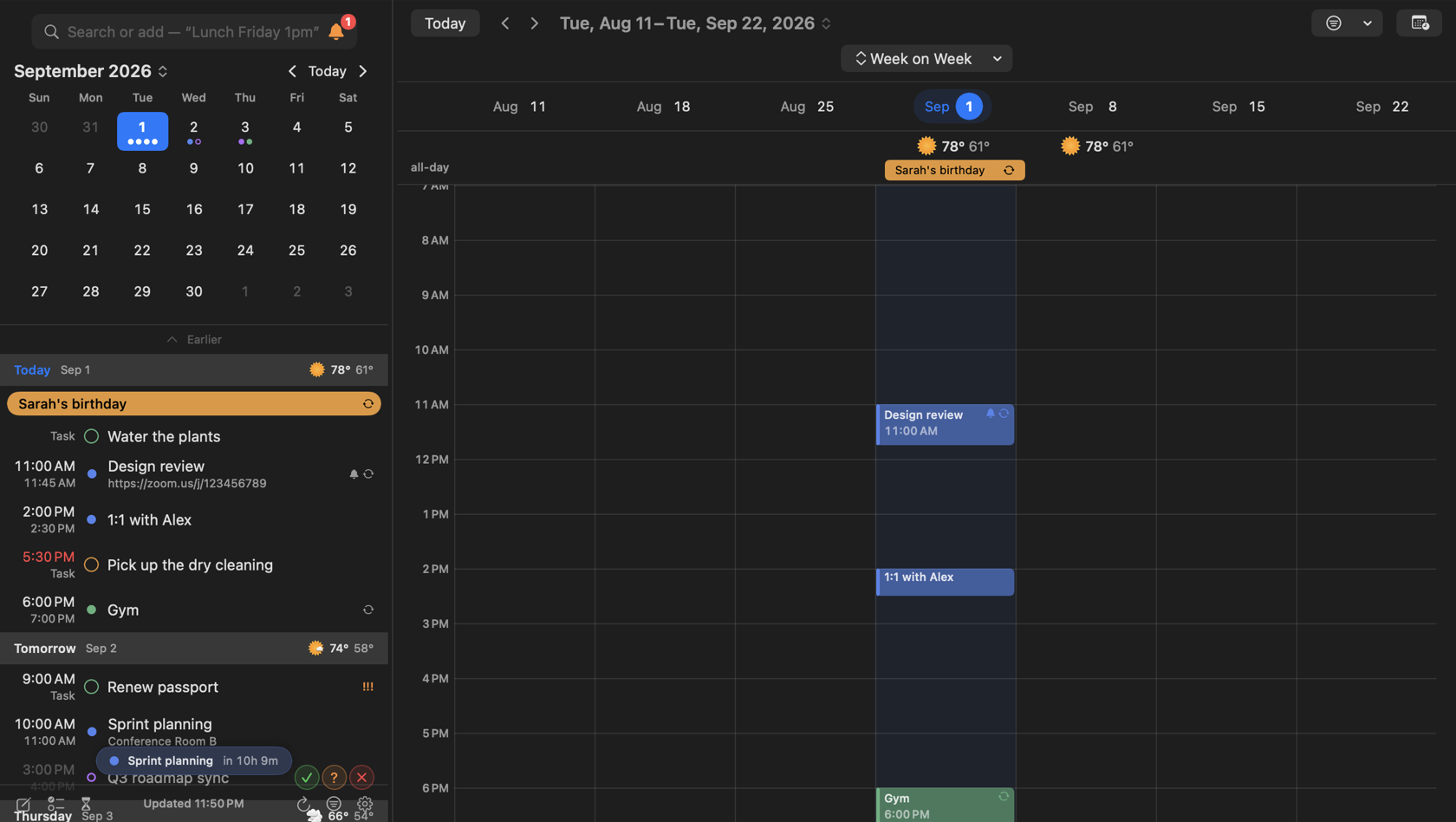
    Seven of the same weekday, side by sideMac

    Week on Week lines up one weekday from seven weeks in a row, so the shape of the weeks ahead stands out at a glance. Every column is the same day of the week, the all-day strip and weather ride along with each one, and the day you are on is marked in the header.

    Switch it on under Settings ▸ Appearance ▸ Calendar, then choose it from the view switcher. The arrow buttons or a swipe slide the whole row a week at a time.

    InstaCal's calendar window on Mac in Week on Week view with seven Tuesday columns from August 11 to September 22, an all-day strip carrying Sarah's birthday, and Design review, 1:1 with Alex and Gym on the highlighted current Tuesday beside the agenda sidebar
    Every Tuesday for seven weeks, in one row.

    This event, or all future onesMac

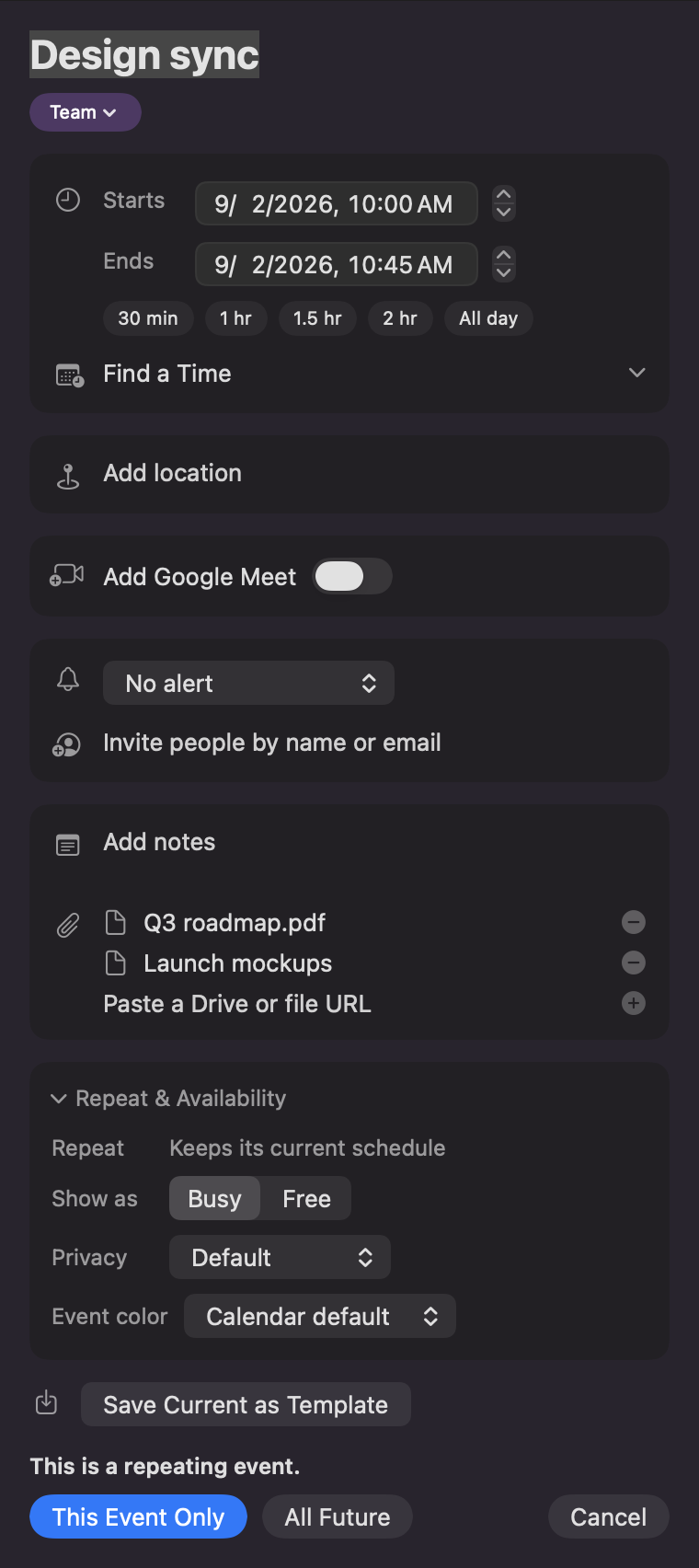
    Editing one occurrence of a repeating Google or Outlook event now asks which occurrences you mean. Save on a series event offers This Event Only or All Future right in the editor, and the same question reaches deleting, rescheduling and a drag in the grid — the choice Apple calendars have always had.

    Guests hear about what changed, and replying to one occurrence of a repeating invitation answers for the whole series.

    The Mac event editor for a repeating Google event named Design sync on the Team calendar, with the inline question This is a repeating event and the buttons This Event Only, All Future and Cancel beneath the form
    Save asks which occurrences you mean.

    Plus 23 smaller changes — fixes, tidy-ups and one-line wins that didn't need a paragraph. See every line →

    Everything in this release

    • Countdowns keep the dates that matter in sight. Add any calendar event, or a date that lives nowhere else, and watch it from the desktop, a widget or the menu bar itself. One set on a repeating event follows the series, so a birthday or a weekly review rolls forward on its ownMac
    • Ten widgets, each configured on its own — agenda, month, next event, now and next, week map, days ahead, countdowns and reminders, every one with its own calendar set, theme, text size, privacy and weather. And they act without opening the app: flip through months, page a busy day in place, look ahead a week at a time, and check off a reminder right on the widgetMac
    • Invitations keep asking until you answer. A bell holds every unanswered one, including those on a calendar you have hidden, and you reply with Accept, Maybe or Decline from the agenda row, from a right-click on the calendar, or from the invitation itself. A meeting you have not answered is drawn as unanswered rather than settled, and one you declined stops taking up your dayMac
    • Repeating events on Google and Outlook calendars now ask the question Apple's have always had: change this event only, or all future events? Editing, deleting, rescheduling and dragging in the grid all offer the choice, guests hear about what changed, and replying to one occurrence of a repeating invitation answers for the whole seriesMac
    • Plan around what is already there. Availability Sharing turns your open times into text, images, PDFs or calendar files without publishing your calendar. Conflict Blocking mirrors private events onto another calendar as generic Busy blocks, details left behind. Schedule warnings flag overlaps, travel pressure and short breaks as notifications before the crunch rather than after itMac
    • Smart Filters turn a search, a set of calendars, rules and view settings into a workspace you can return to. A rule can require a word or exclude one, match the hour an event starts or the day of the week, and your filters wait in the View menu with a shortcut key of your own. Calendar Sets can follow your Focus modes, and quiet hours hold back every kind of interruption until the window closesMac
    • A new Week on Week view lines up the same weekday from seven weeks side by side — every Monday in a row — so the shape of the weeks ahead stands out at a glance. Switch it on in Settings, then slide the row a week at a time with a swipe or the arrow buttonsMac
    • The menu bar panel is yours to arrange. Drag its toolbar buttons into the order you want, hide the ones you never press, and put an Up Next bubble above them naming what is next and how long you haveMac
    • VoiceOver reads the calendar rather than its pieces. Every agenda row, month chip, time-grid block and list row is one spoken sentence with its controls on the actions rotor, around seventy icon-only buttons gained real names, and Reduce Motion is honoured throughoutMac
    • Google and Outlook sync stands sturdier: a rate limit or server hiccup retries itself with the service's own back-off, Teams meetings keep their join links through an edit, other guests' replies survive yours, and an account's calendars are read in full however many there areMac
    • Calendars come in and out freely: import and export .ics files with a duplicate preview before anything is written, print what you are looking at, open and add event attachments, and keep Google and Outlook colours, categories, privacy and guest permissions intactMac
    • Apple Watch becomes a place to act. Eleven complications — Now & Next, Up Next, Day Timeline, Leave By, Tasks Due, Today's Load, Date & Next, Countdowns, Join Next, Conflict Check and Open Window — sit on your watch face and in the Smart Stack, and each one knows when it matters: Join Next rises before a video call, Leave By around the time you need to move, Tasks Due when something is overdueiOS
    • Answer an invitation from your wrist without opening anything. An unanswered invitation carries Accept and Decline on the tile itself, and a reminder checks off from Tasks Due in placeiOS
    • Every face placement can have its own job — its own calendar set, events or reminders, look-ahead and privacy level — so a work face and a weekend face show different schedules without touching the calendars on your phoneiOS
    • A conflict tells you what it costs. An overlapping event now gets a card of its own naming the other event and how long they collide for, the exact minutes in dispute, and a timeline drawing both events on one axis with the disputed stretch marked. Tap it for the ways out — an open time to move to, shortening it, marking it free — and set a calendar you can see but cannot act on to stay out of conflict checking entirely, under Settings ▸ Alerts ▸ Schedule WarningsiOS
    • Smart Filters narrow every view, not just the agenda. Rules can match a title, location, notes or attendee — or exclude them — and narrow by start time, by weekday, by all-day or timed, busy or free, recurring or not. Combine them with All Rules or Any Rule, and let a filter switch you to the view that suits itiOS
    • A new Week on Week view lines the same weekday up across seven weeks, so you can see at a glance which Mondays are already spoken for. Switch it on in Settings ▸ Gestures & NavigationiOS
    • The compact view switcher scrubs: press it, slide up, and the views rise above your finger, naming where you are going as you pass over them. Lift to land there, or slide back to take it backiOS
    • Editing or deleting one occurrence of a repeating Google or Outlook event now asks whether you mean this event or all future ones — the same question Apple calendars have always answered, and it reaches the editor, the event card, the agenda swipe, the month view and a drag in the Day and Week grids. Replying to one occurrence of a repeating meeting answers for the seriesiOS
    • The agenda's day header stays pinned as you scroll, and reads Up Next while you are resting on your next event — folding away the meetings already behind you, and moving on to tomorrow once today is genuinely spentiOS
    • The agenda opens on today and stays there while the app loads, instead of drifting days ahead as late content arrives above itiOS
    • Google and Outlook sync rides out a rate limit instead of failing on first touch, reads an account's calendars in full, and stops a Teams meeting's join link from being lost to an unrelated edit. Apple calendars stay complete when you page years ahead, and editing one occurrence of an old repeating series touches the occurrence you actually pickediOS
    • On iPad, Week and Day page under a swipe, Quarter draws its months as cards that survive a rotation, and a View menu puts Day through Year on ⌘1–⌘5 with Agenda on ⌘6iOS
  5. MaciOS

    Plan the week, privately

    Reusable calendar workspaces, conflict-free meeting suggestions and cross-calendar Busy blocks come to InstaCal.

    Your place in the List, reflected everywhereMac

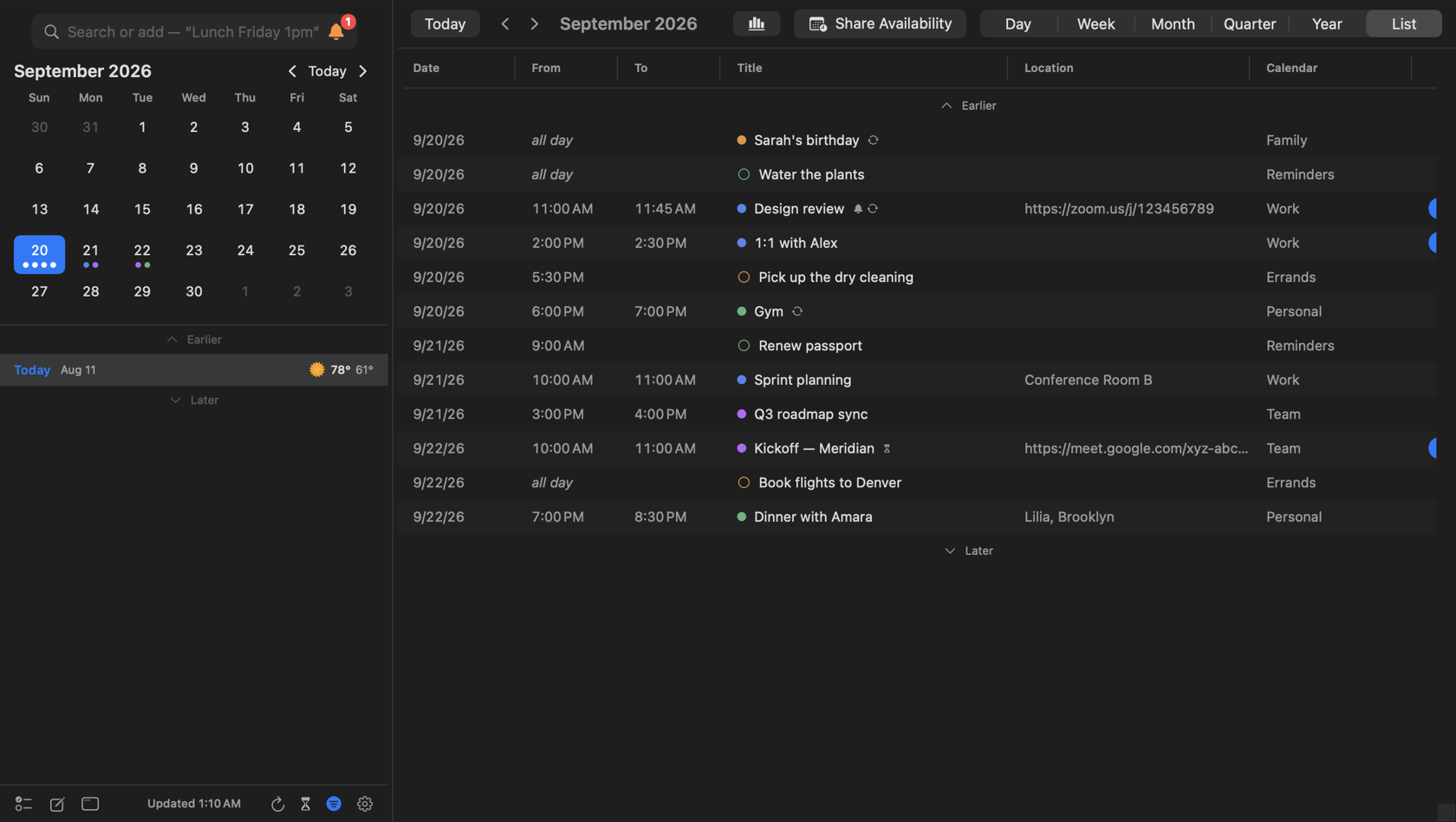
    Scroll the full-window List and both calendars move with the events in view. The mini calendar, selected day and main month heading stay together while earlier and later ranges load, so the date in the chrome never drifts away from the rows beneath it.

    Month names turn like a vertical dial: a quick flick gets a tight transition, a slower scroll has a little more room to settle, and every title stays whole. At compact window widths, controls reflow and event details undock before either pane gets squeezed.

    InstaCal List view on Mac scrolled into September 2026, with September shown in both the left mini calendar and center heading and September 20 selected beside matching List rows
    One scroll position. Both calendars in step.

    Every button, where your thumb expects itiOS

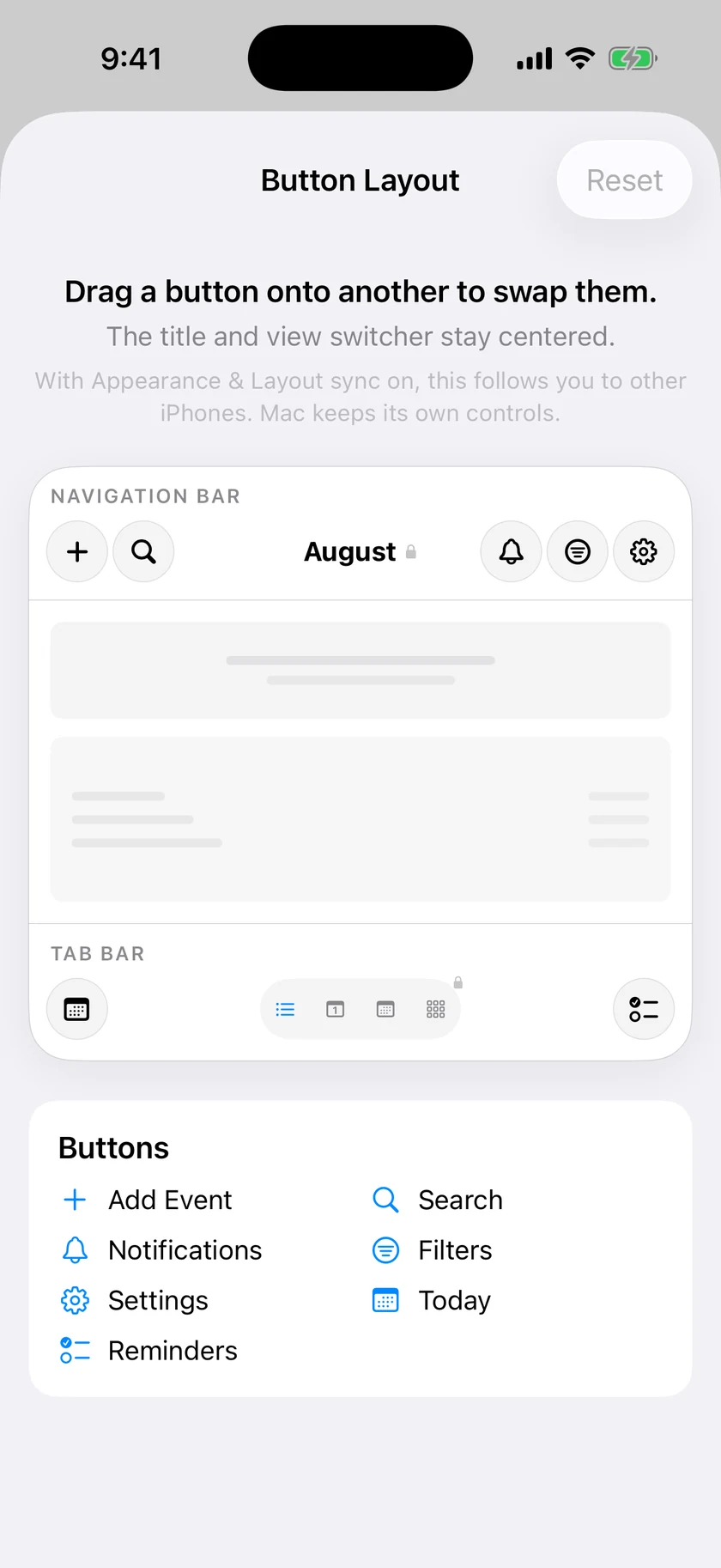
    Choose Reorder, then drag any iPhone command onto another to swap their places. Add Event, Search, Notifications, Filters, Settings, Today, Reminders and Countdowns can move around the fixed month title and view switcher, with a shell preview showing exactly where each button will land. Done applies the arrangement; Cancel leaves the live bars untouched.

    Countdowns stays out of the standard layout until there is something active to follow, but an explicit custom placement keeps it visible. Choose the compact view switcher on the same screen and Reminders and Countdowns stay in its menu without hiding the other commands you placed there. The arrangement follows you to other iPhones when Appearance & Layout sync is on; Reset restores both the standard command order and expanded switcher.

    Button Layout editor on iPhone showing seven draggable commands arranged around a fixed August title and view switcher
    The controls move. Your anchors stay put.

    Browse the calendar without leaving the widgetiOS

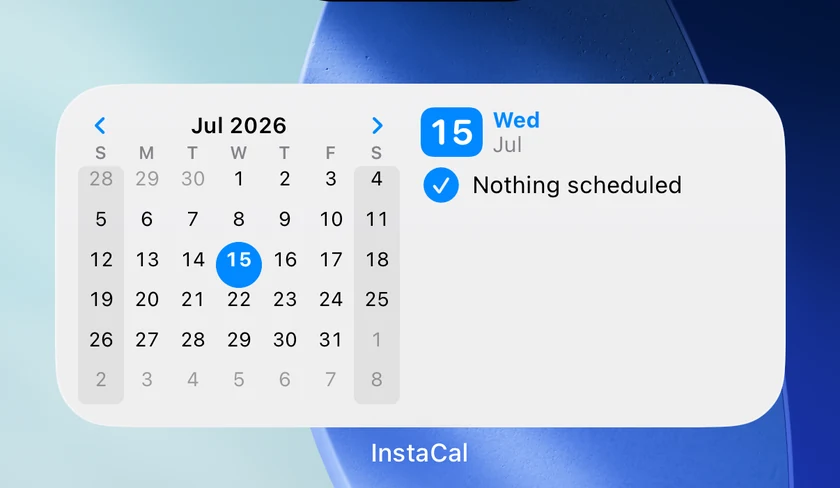
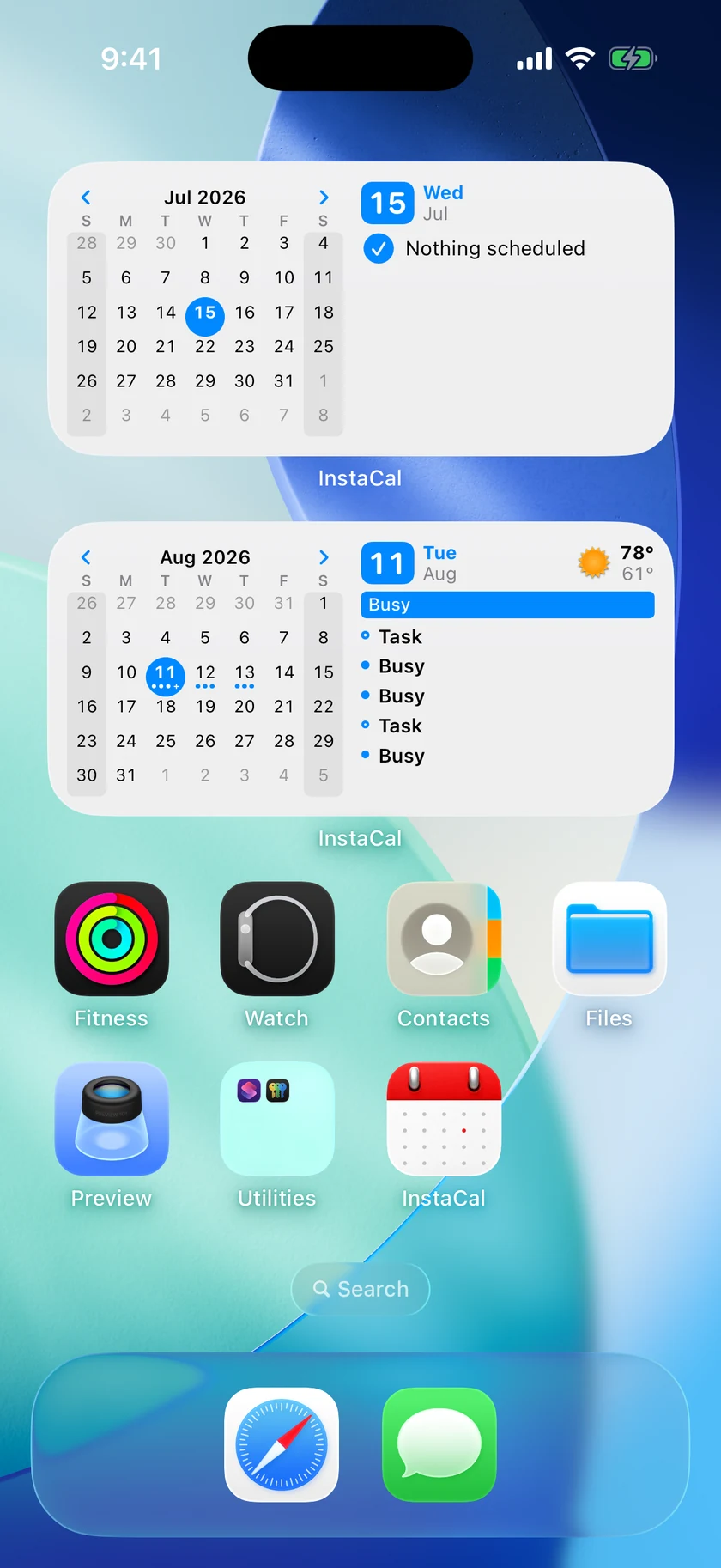
    Up Next + Calendar browses entirely in place by default. Use the arrows to move through complete calendar months, tap any date, and the agenda beside it immediately becomes that day's events and reminders without leaving the widget. Turn off Interactive Calendar for a placement when you prefer date taps to open InstaCal instead.

    The capture is the live result after selecting July 15: the month title, boxed selection and adjacent Wednesday, July 15 agenda all agree, with the navigation arrows ready for another month. Taps now hand state directly to the next render, so the widget no longer flashes an old page while it catches up.

    Interactive Up Next and Calendar widget with month arrows, July 2026 title, July 15 selected and a matching Wednesday July 15 agenda
    Choose the month. Choose the day. Stay on the Home Screen.

    Your calendar, as a workspaceMac

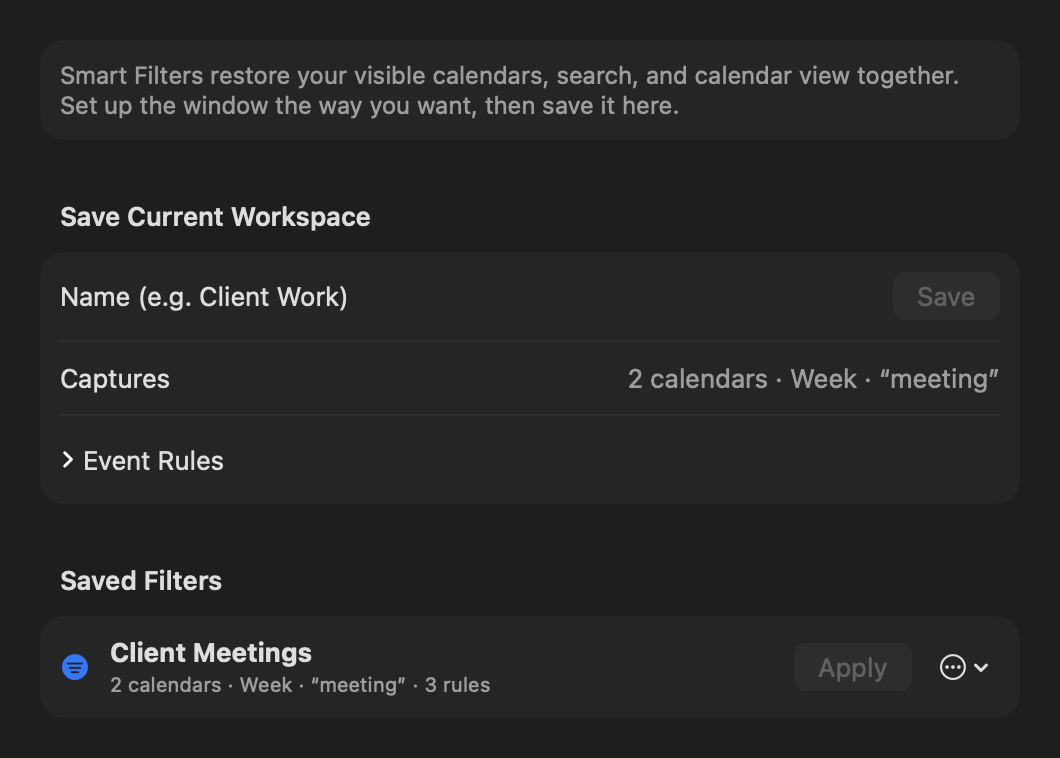
    Smart Filters save more than a search. Pick the calendars you want, add rules for the events that matter, choose a view, and save the whole arrangement as a workspace you can return to.

    Calendar ordering now carries through the rest of InstaCal too. When events begin together, the order you chose decides how they appear in the panel, calendar window and widgets.

    Smart Filters settings with a saved Client Meetings workspace combining two calendars, Week view, a meeting search and three rules
    Calendars, search, rules and view — saved together.

    Find the time that actually worksMac

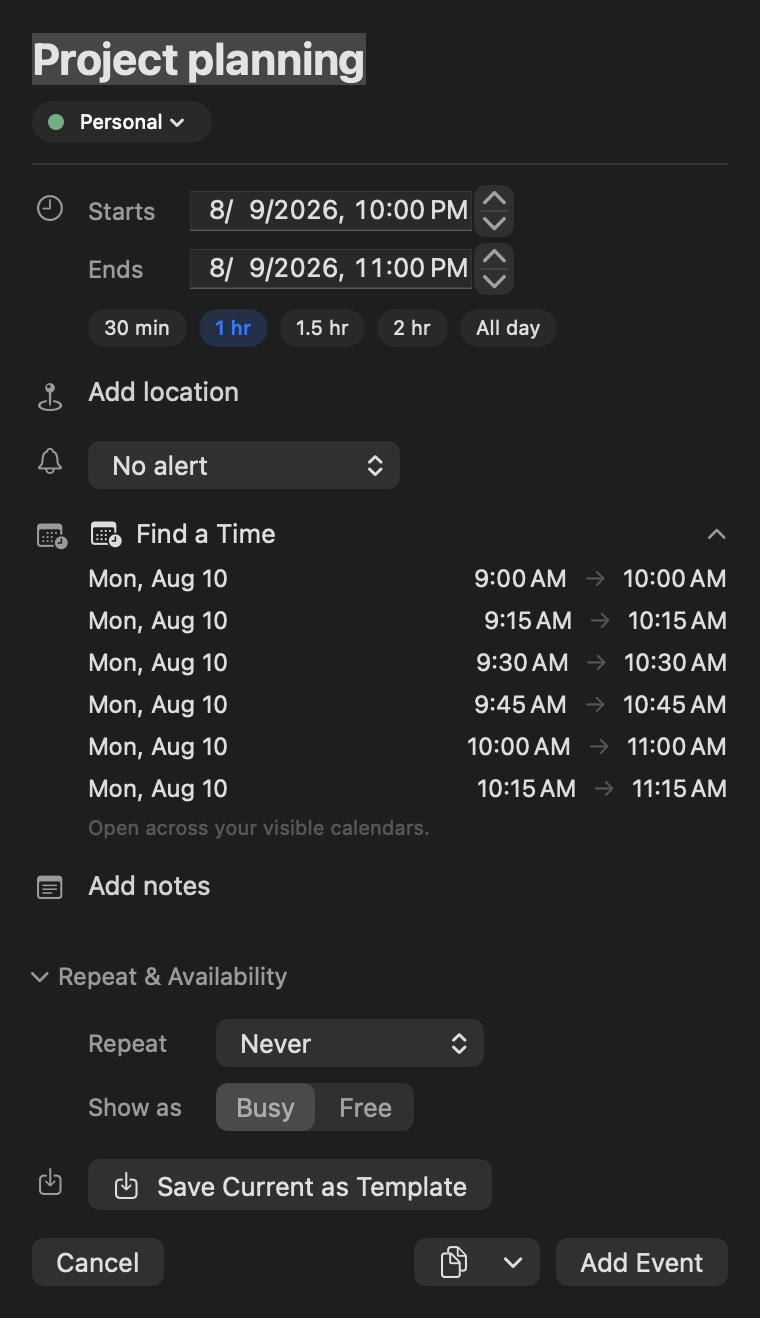
    Find a Time checks the calendars in front of you and offers open meeting slots. Working hours and conflict warnings keep suggestions inside the day you meant to work, while travel estimates account for the journey when a meeting has somewhere to be.

    Templates take the repetition out of setting the meeting up again: save only the event or reminder fields you want to reuse, under a name that makes sense later.

    A Project planning event editor showing six suggested one-hour meeting times under Find a Time
    Open times appear inside the event you are already planning.

    Choose the warnings that matterMaciOS

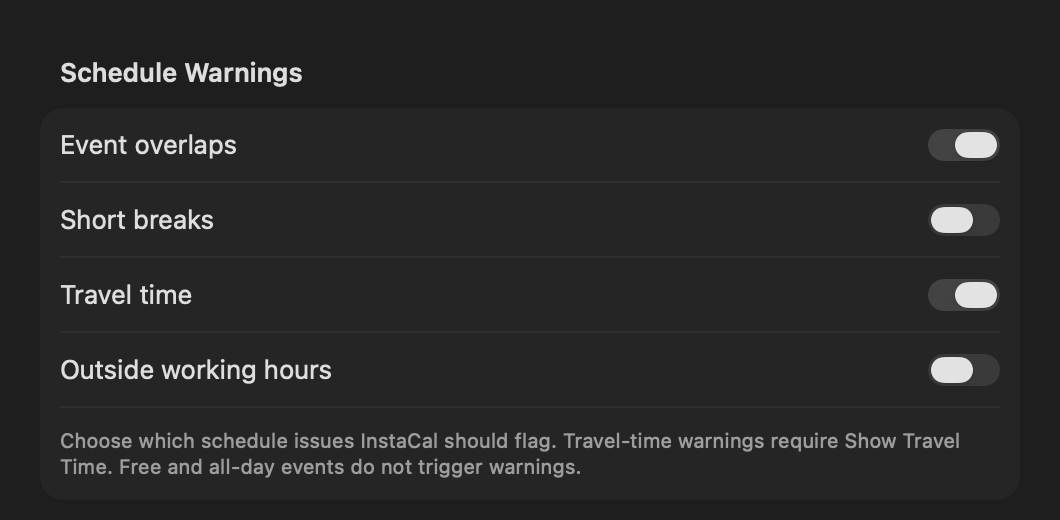
    Schedule warnings are four independent choices. Keep event overlaps and travel pressure visible without being told about short breaks or plans outside working hours—or choose any other combination that fits how you use your calendar.

    Event-overlap and travel-time warnings start on. Short-break and outside-working-hours warnings stay off until you ask for them, and travel pressure appears only when Show Travel Time is enabled.

    Schedule Warnings settings with separate switches for Event overlaps, Short breaks, Travel time and Outside working hours
    Keep the warnings you use. Leave the rest quiet.

    Share busy, not privateMac

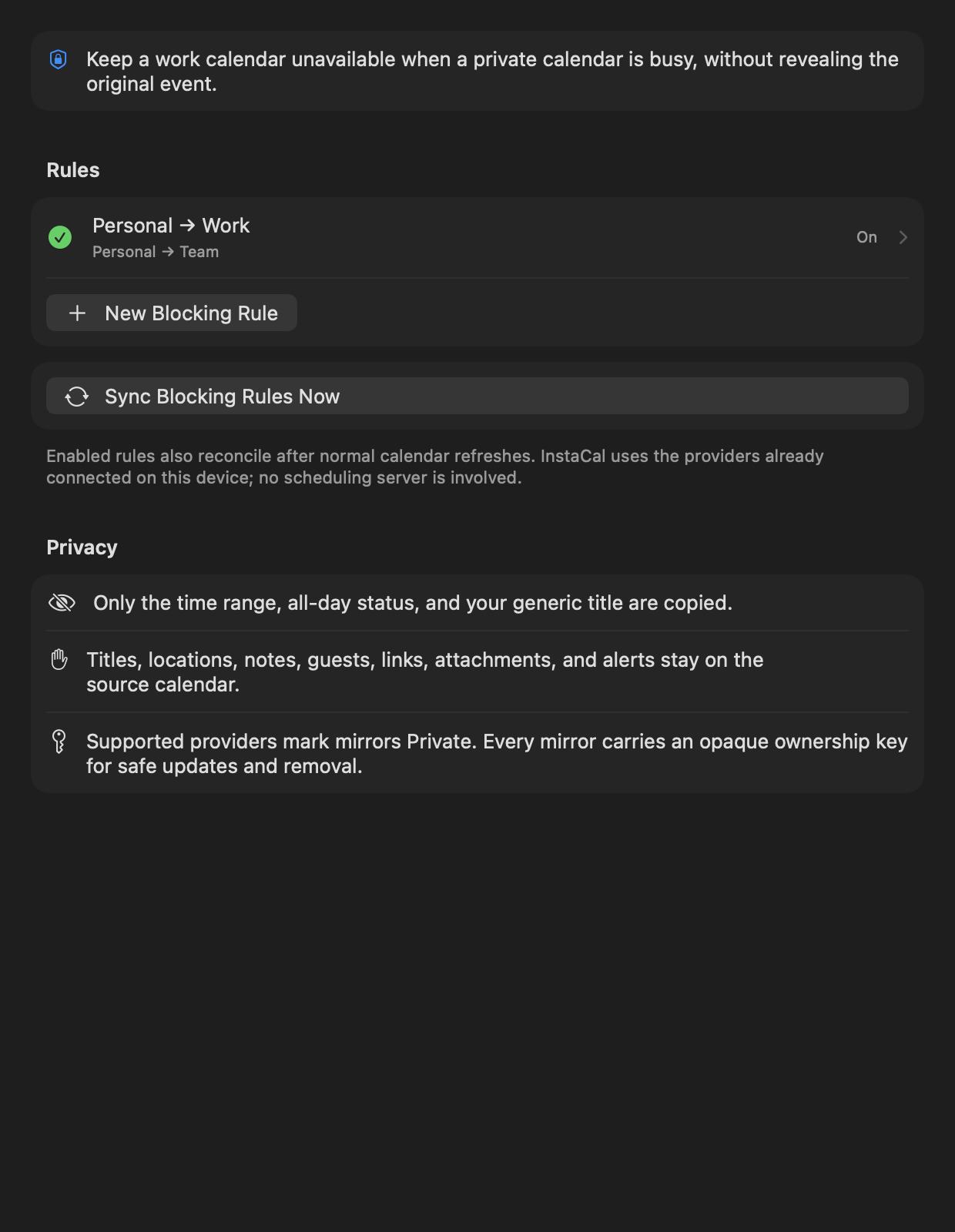
    Conflict Blocking keeps one calendar unavailable when another is busy without copying the private event. The destination gets only a generic Busy block; titles, locations, notes, guests, links, attachments and alerts stay where they belong.

    The same release brings attachments and richer provider details to supported Google and Outlook events, plus Calendar Sets that can follow Apple Focus modes and restore your previous selection when the Focus ends.

    Conflict Blocking settings with an enabled Personal to Work rule and a privacy summary of the details that are never copied
    Only a generic Busy block crosses calendars.

    The dates that matter, already on your calendariOS

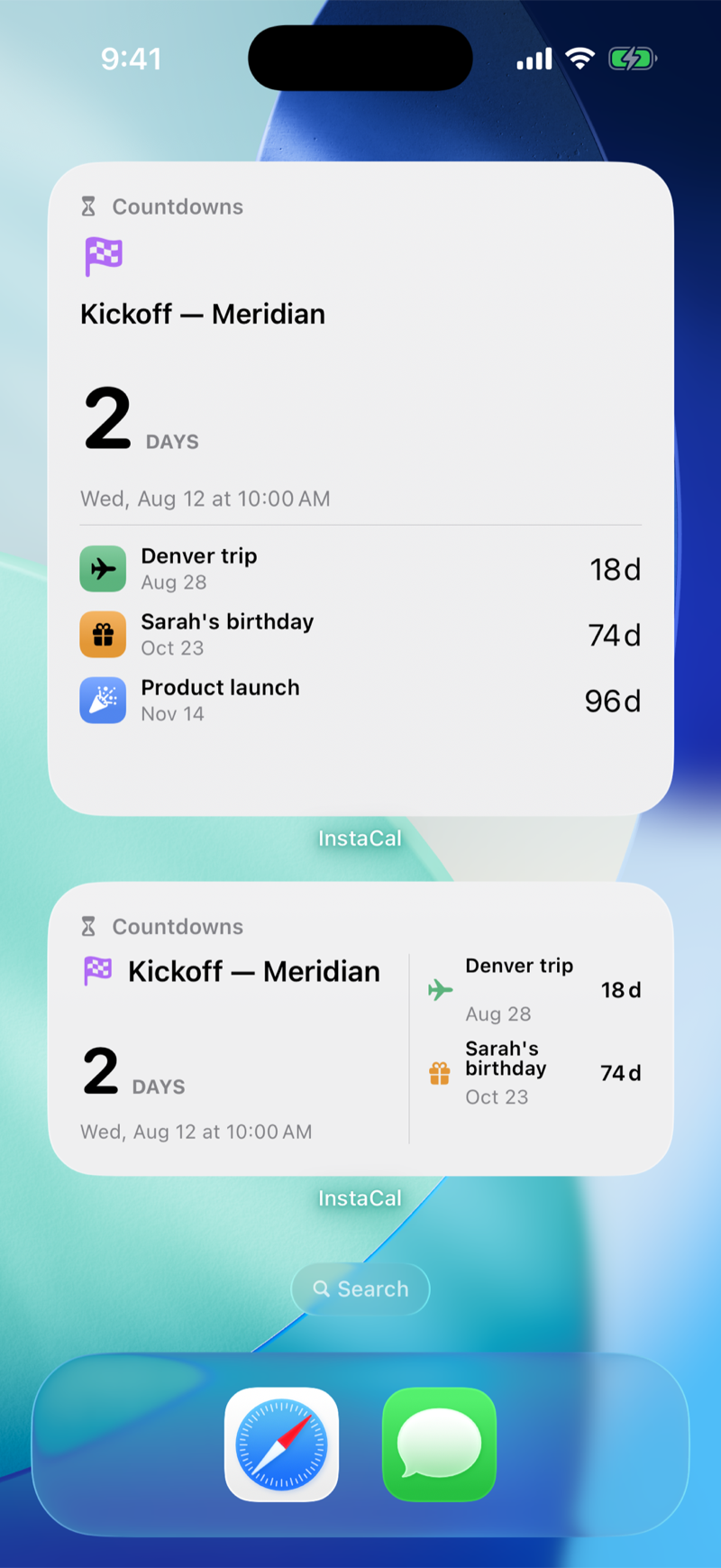
    Choose Add to Countdowns on any event, or add a date of your own. A calendar-linked countdown keeps the event's name, time and calendar color, and opens that exact event when you tap it. A standalone date — a birthday, a trip, a launch — lives nowhere else and takes an optional time, a yearly repeat, a symbol and a color.

    Widgets scale with the space you give them: one big date at small, three at medium, five at large and nine at extra large, plus inline, circular and rectangular versions for the Lock Screen. Each Countdowns widget can watch its own date, so two widgets need not show the same thing.

    iPhone Home Screen with large and medium Countdowns widgets showing Kickoff — Meridian at 2 days, Denver trip at 18 days, Sarah's birthday at 74 days and Product launch at 96 days
    One big moment—or the whole lineup.

    The same important dates, ready on your MacMac

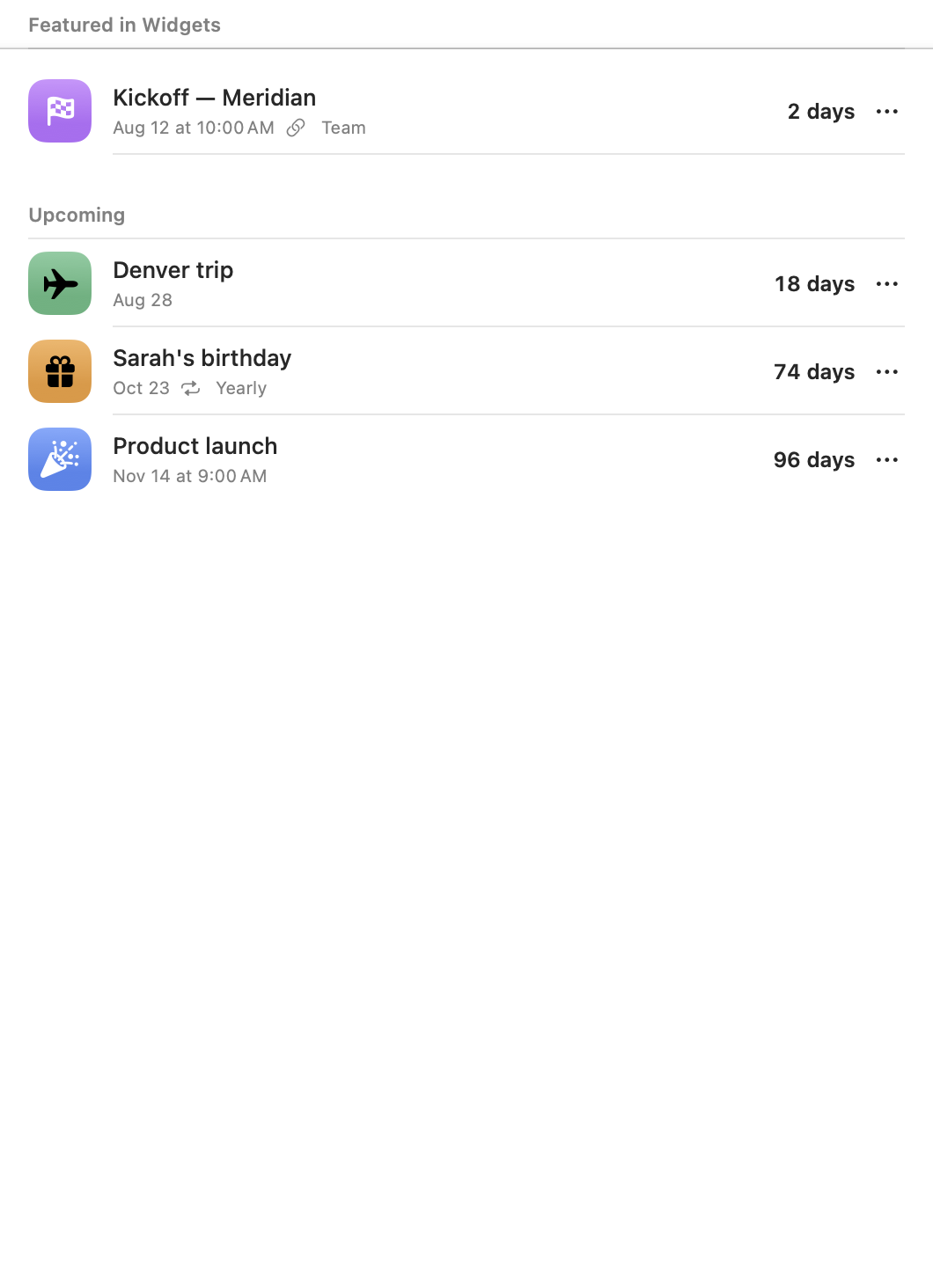
    Settings ▸ Countdowns keeps the dates you care about in one place. Add any calendar event from its actions menu, or create a date that lives nowhere else. Event-backed rows carry their source calendar; standalone dates stay directly editable.

    Desktop widgets show one big date or up to nine, and each one can watch its own date. Yearly dates advance to the next occurrence on their own, and a countdown whose event goes missing says so plainly and keeps its last known date rather than pretending.

    Countdowns settings on Mac with Kickoff — Meridian featured in widgets above Denver trip, Sarah's birthday and Product launch
    Feature one date. Keep the rest close.

    Countdowns on your wristiOS

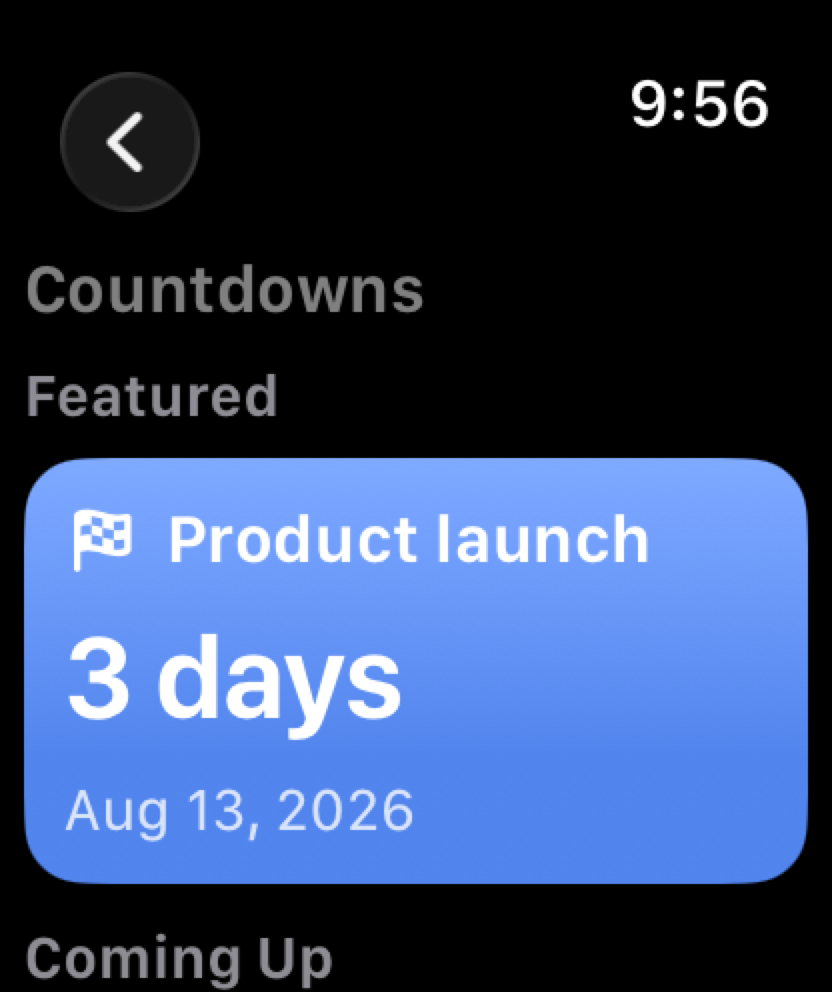
    Apple Watch gets the full list, a detail view for every date, and a complication of its own. The featured date leads, and a linked countdown opens the calendar event behind it.

    Countdowns arrive alongside a broader Watch release: Conflict Check, Join Next and Open Window complications; editing, moving, rescheduling, answering and snoozing from the wrist; Month and 3-Day views; and honest queued status when your iPhone is out of range.

    Apple Watch showing the Countdowns list with the featured Kickoff — Meridian at 2 days above further upcoming dates
    The next date that matters, on your wrist.

    The next date that matters, in the menu barMac

    Your featured countdown can sit in the menu bar, beside the date and your next event. Show it with its title or as a compact value, and give Countdowns a keyboard shortcut so the list opens from anywhere.

    Everything shares one length budget, so adding a countdown never crowds out the date or the event you are about to walk into.

    The InstaCal menu bar status item showing Monday the 10th and the featured Kickoff — Meridian countdown at 2 days
    The next date that matters, without opening a window.

    Already on your calendarMac

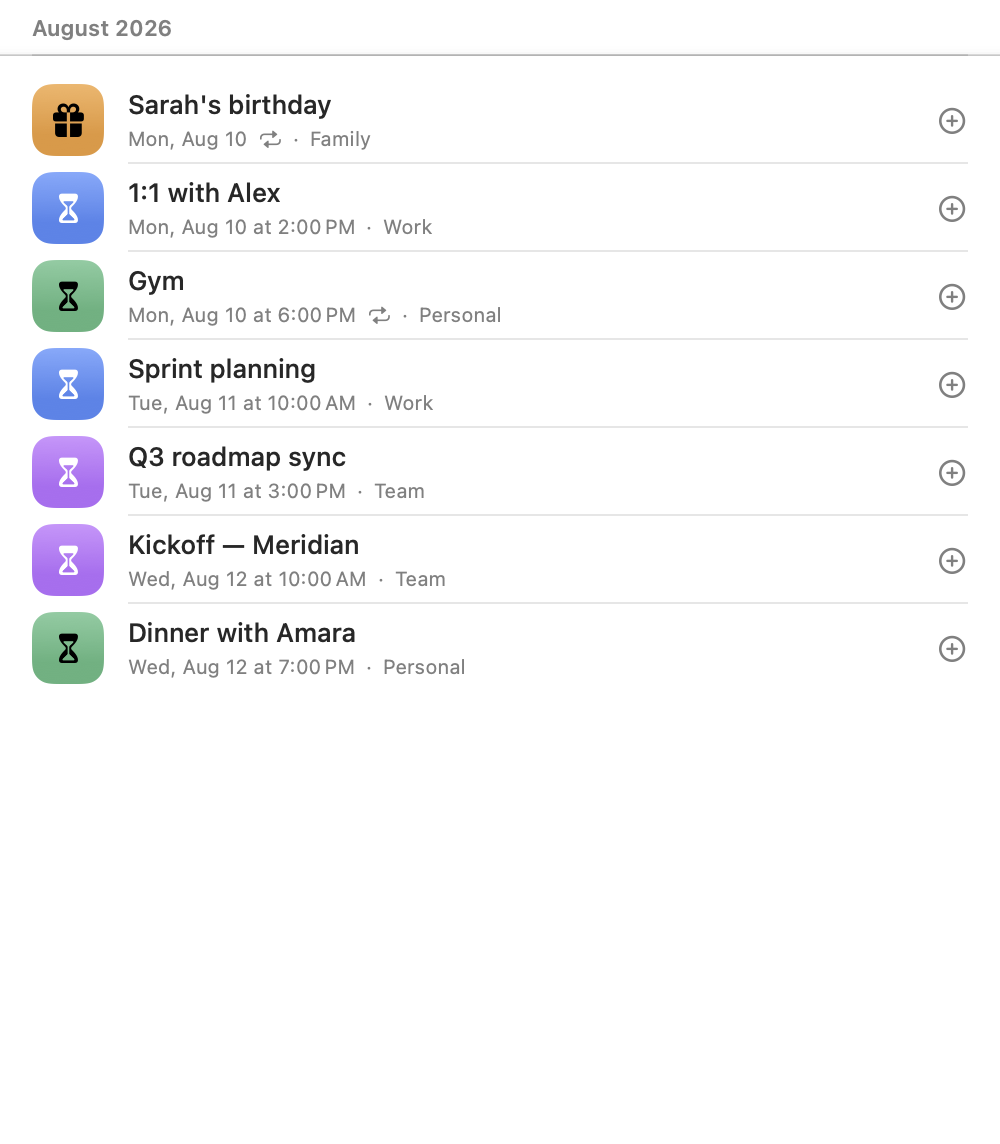
    From Calendar turns any upcoming event into a countdown without hunting for it in the month grid. A birthday, a trip, a launch, a review — pick it from the list and it keeps the event's name, date, calendar and colour.

    Countdowns on repeating events now follow the series rather than expiring after one occurrence, so a birthday or a weekly review rolls forward on its own. Name a countdown after a birthday or anniversary and a yearly repeat is suggested for you, and the symbol is chosen from the name — in every language InstaCal speaks.

    The From Calendar chooser on Mac listing upcoming Family, Personal, Work and Team events including Sarah's birthday and Kickoff — Meridian, each with its date, recurrence and calendar
    Already on your calendar. Now one click from your widgets.

    Already on your iPhoneiOS

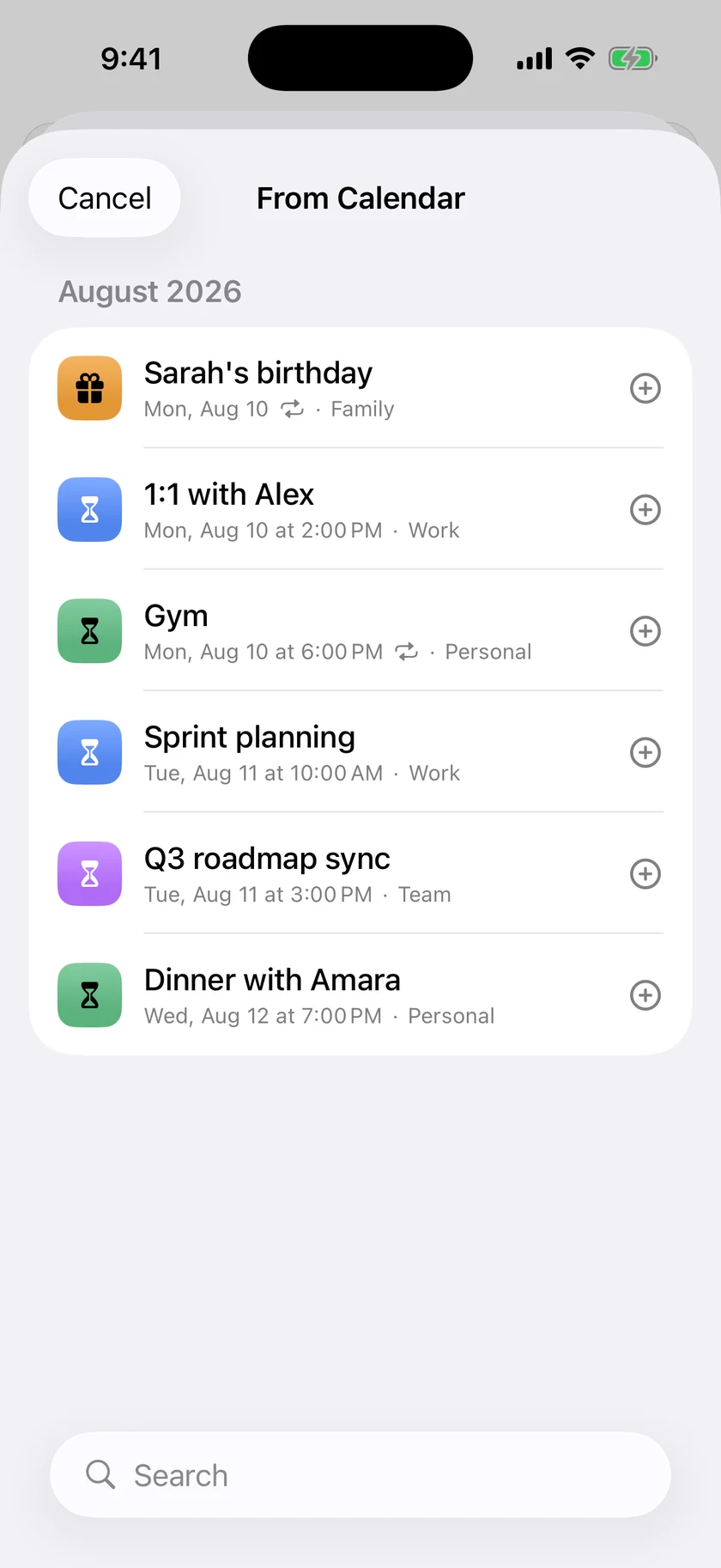
    From Calendar puts the same upcoming-event chooser on iPhone. Pick a birthday, meeting, trip or launch from the list and InstaCal carries its name, date and source calendar into Countdowns.

    Repeating events keep following the series instead of expiring after one occurrence, and tapping a linked countdown opens the calendar event behind it.

    The From Calendar chooser on iPhone listing fictional upcoming events including Sarah's birthday, a one-to-one meeting, Gym and Sprint planning
    An upcoming event becomes a countdown in one tap.

    Every widget, its own wayMaciOS

    Two copies of the same widget no longer have to agree. Each one carries its own Calendar Set, theme, font size, privacy mode, weather visibility and layout, so a widget on your desk can show full details while one on a shared screen shows busy time only.

    Themes follow the system or lock to Light, Dark or a color of your choosing. And with iCloud settings sync, the countdowns, templates, appearance and planning defaults behind them stay consistent across your devices — with no InstaCal account, and three switches you can turn off individually.

    Two legible Up Next and Calendar widgets on an iPhone Home Screen, the upper copy browsing July 15 and the lower copy showing August 11 in Busy Only privacy mode
    Two copies of one widget, configured differently.

    Plus 20 smaller changes — fixes, tidy-ups and one-line wins that didn't need a paragraph. See every line →

    Everything in this release

    • Countdowns keep the dates that matter in sight. Add any calendar event, or a date that lives nowhere else, and watch it from the desktop, a widget or the menu bar itself. One set on a repeating event follows the series, so a birthday or a weekly review rolls forward on its ownMac
    • Ten widgets, each configured on its own — agenda, month, next event, now and next, week map, days ahead, countdowns and reminders, every one with its own calendar set, theme, text size, privacy and weather. And they act without opening the app: flip through months, page a busy day in place, look ahead a week at a time, and check off a reminder right on the widgetMac
    • Invitations keep asking until you answer. A bell holds every unanswered one, including those on a calendar you have hidden, and you reply with Accept, Maybe or Decline from the agenda row, from a right-click on the calendar, or from the invitation itself. A meeting you have not answered is drawn as unanswered rather than settled, and one you declined stops taking up your dayMac
    • Plan around what is already there. Availability Sharing turns your open times into text, images, PDFs or calendar files without publishing your calendar. Conflict Blocking mirrors private events onto another calendar as generic Busy blocks, details left behind. Schedule warnings flag overlaps, travel pressure and short breaks as notifications before the crunch rather than after itMac
    • Smart Filters turn a search, a set of calendars, rules and view settings into a workspace you can return to. Calendar Sets can follow your Focus modes and restore the previous selection when the Focus ends, and quiet hours hold back every kind of interruption until the window closesMac
    • The menu bar panel is yours to arrange. Drag its toolbar buttons into the order you want, hide the ones you never press, and put an Up Next bubble above them naming what is next and how long you haveMac
    • VoiceOver reads the calendar rather than its pieces. Every agenda row, month chip, time-grid block and list row is one spoken sentence with its controls on the actions rotor, around seventy icon-only buttons gained real names, and Reduce Motion is honoured throughoutMac
    • Calendars come in and out freely: import and export .ics files with a duplicate preview before anything is written, print what you are looking at, open and add event attachments, and keep Google and Outlook colours, categories, privacy and guest permissions intactMac
    • Countdowns keep the dates that matter in sight. Add any calendar event, or a date that lives nowhere else, and watch it from the Home Screen, the Lock Screen, iPad and Apple Watch. One set on a repeating event follows the series, so a birthday or a weekly review rolls forward on its owniOS
    • Twelve widgets, each configured on its own — agenda, month, next event, now and next, week map, days ahead, countdowns and reminders, every one with its own calendar set, theme, text size, privacy and weather, and text that follows your device's own Text Size. The calendars are interactive: Month pages between months, Today pages between days, Days Ahead and Week Map page ahead, a crowded day pages in place through "+N events", and a reminder ticks off right on the widget. Countdown to Next and Remaining Today join Week Map, Action Center and Next Event on the Lock Screen, and Action Center puts Add, Search, Today, Join and Directions one tap awayiOS
    • Apple Watch becomes a place to act, not only to look. Edit, move, reschedule, answer and snooze from the wrist with honest queued status when the iPhone is away, eleven complications, and Wrist Notifications that can follow your FocusiOS
    • Both bars are yours to arrange. Every position is shown — empty ones included — so a button is moved rather than traded, either side can hold it, and the view switcher is six spots you rearrange or fold into one compact button. Press and hold that button to jump somewhere and back. Anything you would rather not see goes into the switcher's menu or Hidden ItemsiOS
    • The phone taps back. Completing a reminder, saving an event, crossing a day as the agenda scrolls, crossing a month in the grid, every button on the bars — each has its own weight, the press-and-hold jump taps hardest of all, and Settings ▸ Display ▸ Gestures & Navigation sets how hard it all lands: Off, Subtle or Standard, and picking a level plays itiOS
    • VoiceOver reads the calendar, not its pieces. An agenda row, a month chip or a time-grid block is one spoken element with its controls on the actions rotor, navigation carries the VoiceOver cursor with it, a completed reminder, a sent RSVP and a refresh are announced, Reduce Motion is honored throughout, and the widgets, the Live Activity and the Watch speak what they showiOS
    • Invitations keep asking until you answer. A bell holds every unanswered one, including those on a calendar you have hidden and those that arrived on another of your own accounts, and an invitation you haven't answered looks like one — a washed fill under a dashed edge on the phone, the widgets and the Watch, still counting as busy. You reply right from the agenda row, an hour tile or a month chip, a meeting you declined stops taking up your day anywhere — Up Next, Siri and the Watch included — and a Declined tab keeps every decline reversible, even one made on another deviceiOS
    • Calendar Sets are built and kept on the phone. The filter's own checklist saves as a set, a set can be renamed or rewired in place, a whole account leaves the agenda in one tap, and a set can follow a Focus — filtering the moment the Focus starts, whether the app is open or not, with a switch to see everything for the rest of that FocusiOS
    • Plan around what is already there. Schedule warnings flag overlaps, travel pressure and short breaks before the crunch, the Watch's Conflict Check and Open Window faces name the next collision and the free stretch big enough to use, and Conflict Blocking mirrors busy time onto another calendar without publishing what it isiOS
    • Picking a date is one flick. Months run continuously with every day carrying its event dots, the date and time work as one control, and an event can move to another calendar on Google and Microsoft accounts as well as Apple onesiOS
    • Multi-day events stay present on every day they occupy, all-day events wear solid calendar colours with contrast-aware text, and Join recognizes more than thirty meeting services in links, locations and notesiOS
    • Your settings follow your devices through iCloud, with no InstaCal account — and nothing about you is collected, stored or analyzed by usiOS
  6. MaciOS

    Widgets, and video meetings end to end

    Native Mac widgets for Next Event, Agenda, Month and Up Next — and video links you can add while creating an event, not just open afterwards.

    Widgets come to the desktop. Next Event, Agenda, Month and Up Next, each taking a theme of its own. Up Next carries tomorrow and its forecast; reminders can be ticked off and restored without opening the app; and tapping an event or a day opens the matching place in InstaCal rather than just launching it.

    Reminders finally behave the way they read. One due on a day with no time of day can alert, with its own settings for which day and what time. Ticking one off leaves it in the list struck through, instead of vanishing the evidence that you did it.

    And a second time zone sits beside each event time, for the calls that cross one.

    Right now, then whatiOS

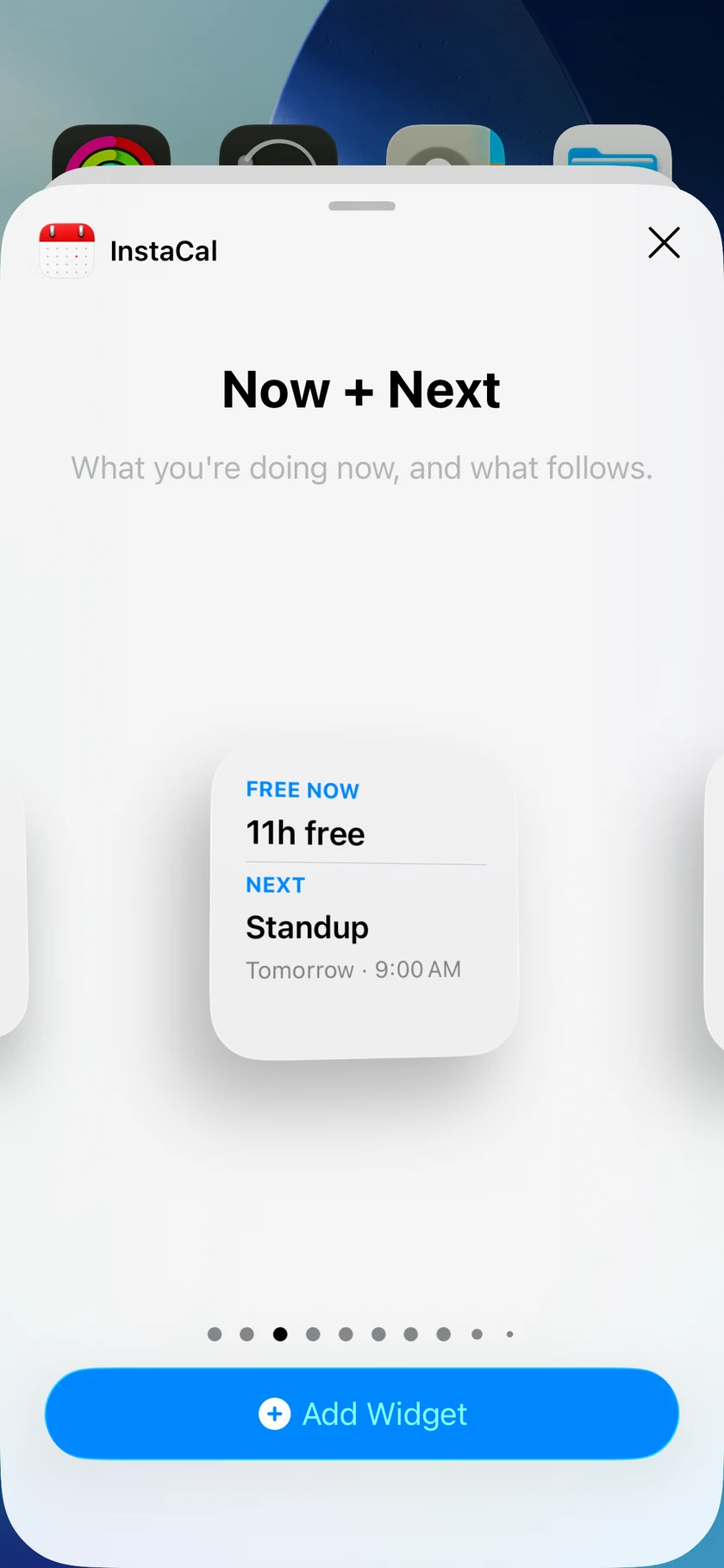
    Now + Next keeps the current commitment, the open window after it and what follows in one glance. Days Ahead carries events, reminders, weather and conflict warnings forward; Week Map turns busy time and open gaps into a shape you can read before opening the app.

    Focused Reminders complete tasks directly from the Home Screen, while expanded small-through-extra-large layouts make the same intelligence useful on iPhone and iPad.

    The InstaCal widget gallery showing Now + Next with an eleven-hour free window and tomorrow's Standup
    Current, free and next — together.

    The right next action, on your wristiOS

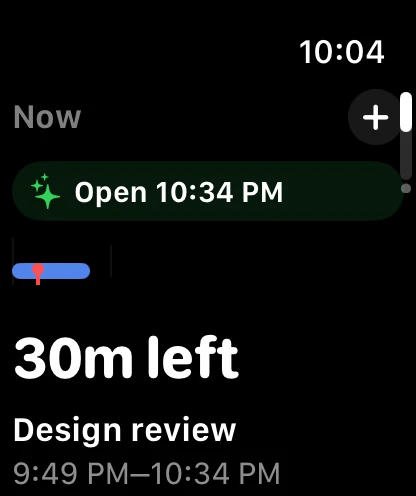
    Apple Watch now moves from knowing to doing. Right Now, Today, Tasks and Week Pulse lead with the schedule context that matters, then surface Join, Directions, Complete, Snooze, RSVP or Quick Add when that is the useful next move.

    Seven focused complications, a seven-day cache and an offline action queue keep the experience useful away from the phone without pretending stale information is current.

    InstaCal Right Now on a 46 millimeter Apple Watch showing an active Design review and the next free block
    The useful next action starts with the right context.

    Video meetings, end to endMac

    InstaCal could already open a video link — now it can create one. Add a Google Meet or Teams call while you make or edit an event, then open it from the event's video card with one Join button and the shareable address directly beneath it.

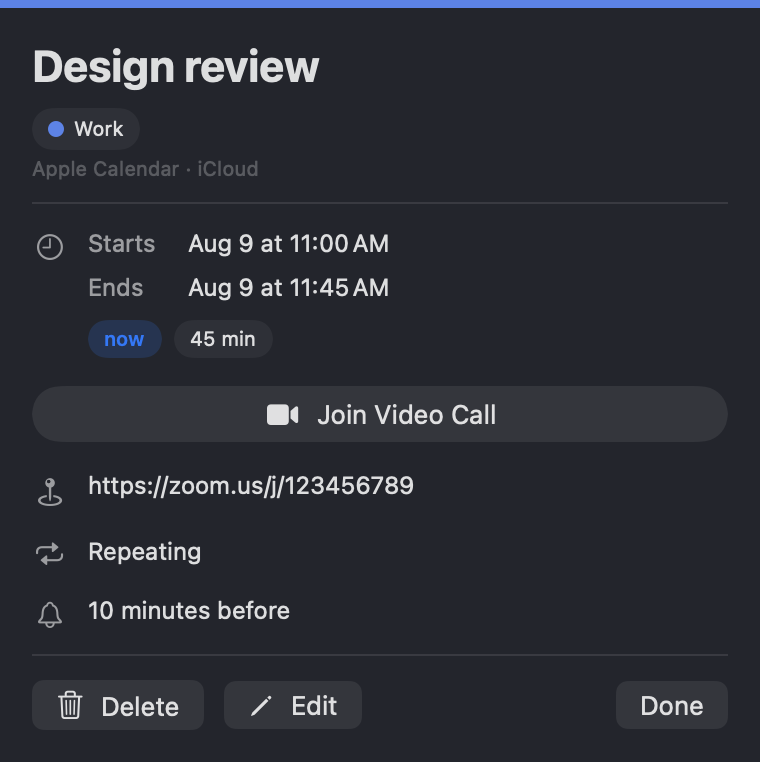
    A Design review event showing a large Join Video Call button and its Zoom meeting address
    One clear Join button, with the address still there when you need it.

    Prefer the short version? See every line →

    Everything in this release

    • Native Mac widgets bring Next Event, Agenda, Month, and Up Next to the desktop. Up Next carries tomorrow and its forecast, reminders can be ticked off and restored without opening the app, and tapping an event or a day opens the matching place in InstaCal. Each widget takes a Theme of its own: System, Light, or DarkMac
    • Video meetings, end to end. Add a Google Meet or Teams link while you create or edit an event, and open one from a card headed by the provider's real name — Google Meet, Microsoft Teams, Zoom, Webex — with the Join button and a shareable address inside itMac
    • A second time zone sits beside each event time, for the calls that cross oneMac
    • Reminders behave the way they read. A reminder due on a day with no time of day can finally alert, with its own settings for which day and what time. Ticking one off leaves it in the list, struck through, instead of making it disappearMac
    • Quick Add reads a day of the month on its own: "the 17th" is a date, while "5th Avenue" stays an addressMac
    • New Google and Microsoft events appear the moment they save, and a calendar InstaCal cannot reach now says so instead of quietly using a different oneMac
    • Weather symbols keep clouds legible while preserving each condition's color, and Classic Color is the default icon styleMac
    • Quick Add understands reminders and noon in every supported languageiOS
    • The Up Next widgets fit more all-day events, follow your calendar order and keep today legible in dark modeiOS
    • Alert lead times include 10 minutes, 2 hours and 1 day, with advance alerts for reminders tooiOS
    • Calendar order controls exact-time ties and every all-day or multi-day lane across the app and widgetsiOS
    • A second time zone stays compact on the same day and adds a date only when the event crosses into another dayiOS
    • Named places such as a gym or restaurant gain maps, directions and travel estimates, while room names leave no empty map behindiOS
    • Event details give RSVP comments more room and lead the schedule with a compact countdown bandiOS
    • Widgets refresh after background calendar changes, and edited Google or Outlook alerts follow the new time immediatelyiOS
    • Phone Month and Week views use clearer titles, labels and sliding transitionsiOS
    • Smart Filters turn searches, calendars, rules and view settings into reusable workspacesiOS
    • Working hours, conflict warnings and Find a Time make it easier to place meetings without collisionsiOS
    • Time-sensitive event, reminder and departure alerts receive the same urgent treatment as Apple’s calendar appsiOS
    • Templates can reuse only the event or reminder fields you choose, under a separate template nameiOS
    • Due reminders stay useful in widgets until completed, while date-only reminders read as AnytimeiOS
    • Event attachments can be viewed, added, downloaded, shared and removed on supported calendarsiOS
    • Google and Outlook events preserve provider details such as colors, categories, privacy, guest permissions and attendee rolesiOS
    • Calendar Sets can follow Apple Focus modes and restore the previous selection when the Focus endsiOS
    • Import and export `.ics` calendars, print visible events and preview duplicate imports before writing anythingiOS
    • Availability Sharing turns proposed open times into text, images, PDFs or calendar files without publishing your calendariOS
    • Time Insights privately reviews meeting load, focus time, after-hours work and recurring-meeting cost on-deviceiOS
    • Conflict Blocking mirrors selected private events as generic Busy blocks on another calendar without copying their detailsiOS
    • Now + Next, Days Ahead, Week Map and focused Reminders widgets reveal current commitments, open time, conflicts and actionable tasks across every useful sizeiOS
    • Apple Watch puts Right Now, Today, Tasks, Week Pulse and the best next action on the wrist, backed by seven focused complications and reliable offline deliveryiOS
    • Long notes keep event details compact, and completed widget reminders retire cleanly after their undo windowiOS
    • Month widgets use their full canvas, while Up Next + Calendar gains per-widget privacy and weather controlsiOS
    • Wrist Control tunes calendar, working-hours, travel and confirmation behavior from the iPhoneiOS
    • Task Lanes keep the right reminders close, with useful grouping, filtering and sorting on the wristiOS
    • Time Shift and Quick Add review changes before saving, warn about conflicts and offer confirmed UndoiOS
  7. Mac

    Eleven more languages, and drag to retime

    InstaCal speaks eleven more languages including Quick Add, events move by dragging them in the grid, and a new Quarter view shows three months at once.

    A big release, and an unusually wide one — it touches the language you use the app in, the way you move an event, and how much of the year you can see at once.

    Eleven more languages — German, French, Spanish, Italian, Dutch, Brazilian Portuguese, Russian, Japanese, Korean and both Chinese scripts. Not just the interface: Quick Add reads dates and times in each of them, which is the part that is actually hard and the part that makes the app usable rather than merely translated.

    Events move by dragging them. Pick one up in the Week or Day grid and drop it where it belongs, in quarter-hour steps, with the new times reading out as you drag. Right-click any event anywhere — the agenda, a month cell, the hour grid, the list — and get the full menu: Edit, Duplicate, Reschedule, Move to Calendar, Join Video Call, Get Directions, Share, Delete.

    Quick Add takes commands now, not just new events: "move gym to 7pm", "cancel dinner friday", with a preview of exactly what Return will do before you press it.

    A new Quarter view shows three months at once, and Year was reworked with larger day cells and event indicators you can render as dots, bars, or a timeline that draws each day's shape by duration.

    Underneath all of it, InstaCal is markedly faster — changing a setting no longer stalls the menu bar, and Month and Year stay smooth with a large calendar loaded.

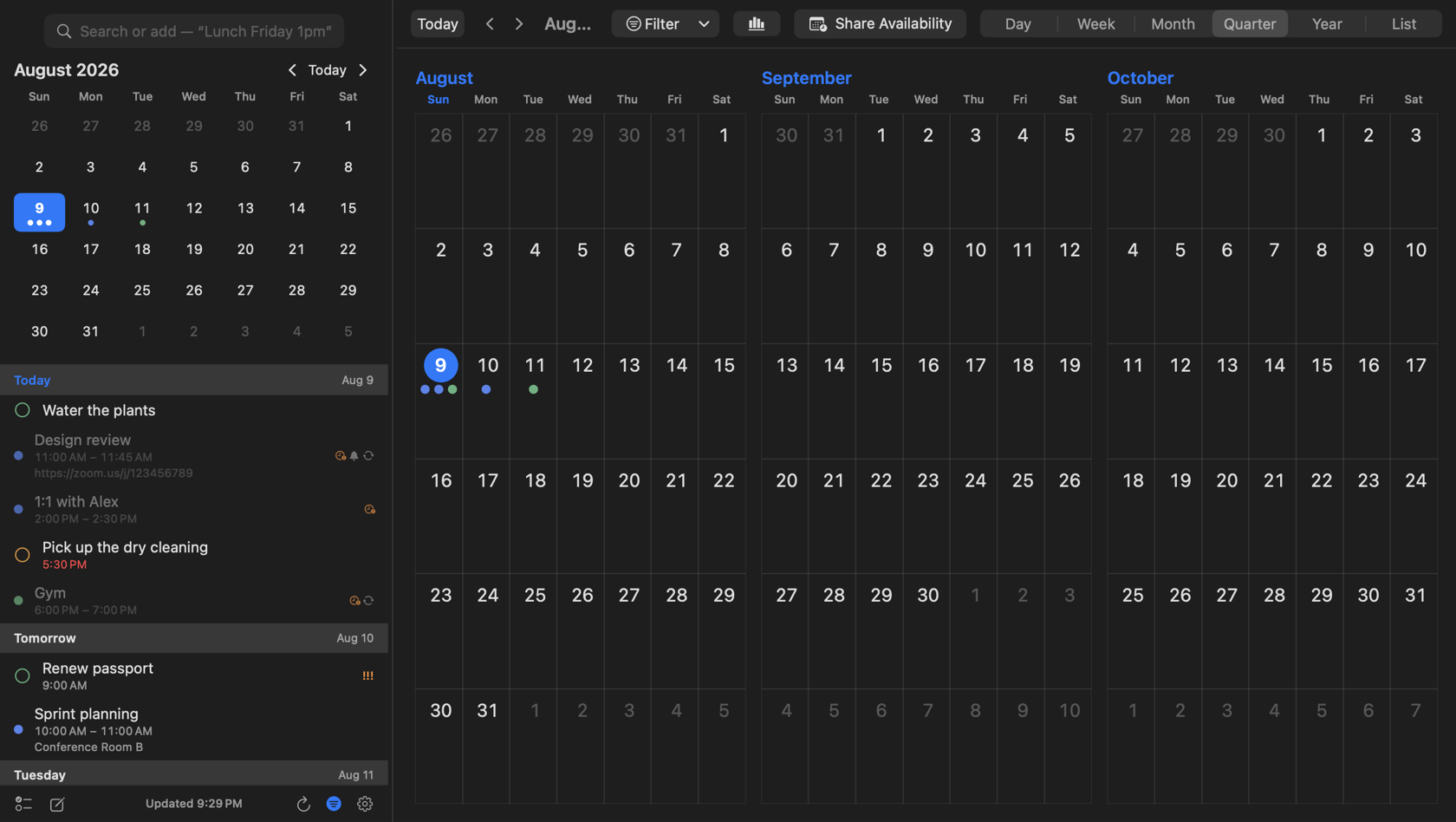
    InstaCal Quarter view showing August, September and October together with event dots on their days
    Three months at once, with the shape of the quarter still visible.

    Quick Add fills in the detailsMac

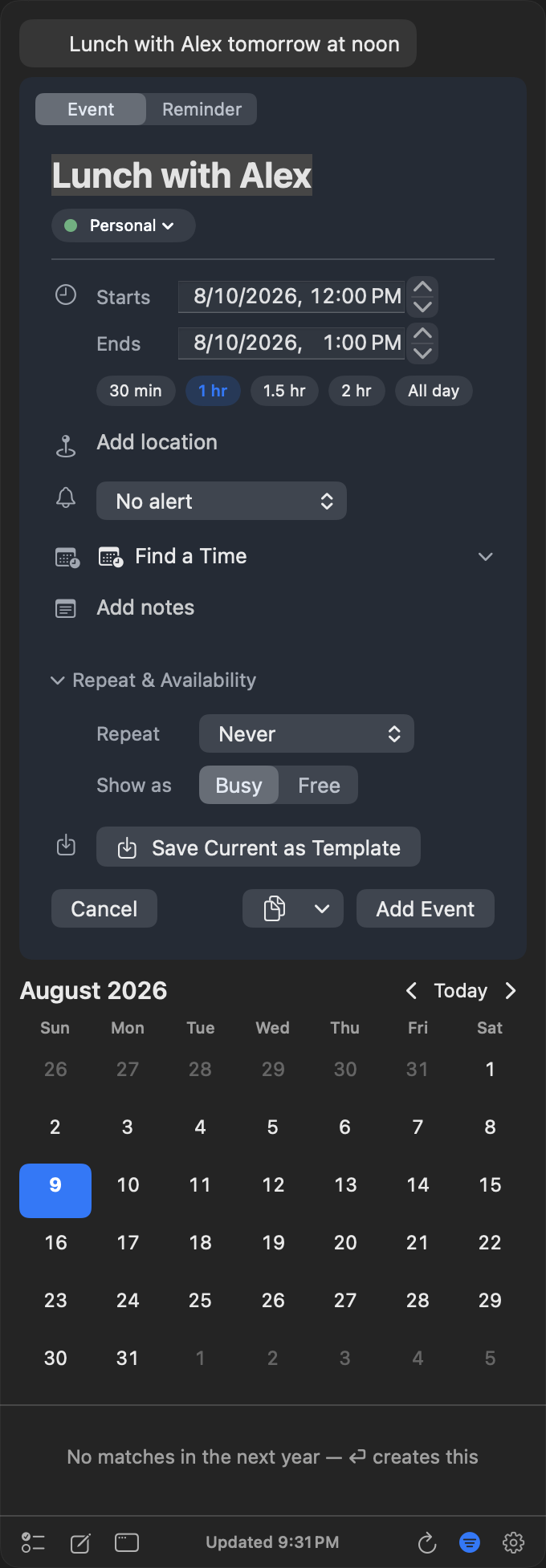
    Quick Add understands the date and time inside an ordinary sentence and shows the complete event before you save it. In this release that parser learned every newly supported language, and the same field also learned commands such as “move gym to 7pm” and “cancel dinner friday.”

    Quick Add turning Lunch with Alex tomorrow at noon into a complete event for the next day from noon to 1 PM
    Type the sentence; InstaCal fills in the event.

    Prefer the short version? See every line →

    Everything in this release

    • InstaCal now speaks eleven more languages — German, French, Spanish, Italian, Dutch, Brazilian Portuguese, Russian, Japanese, Korean, and both Chinese scripts — and Quick Add reads dates and times in each of them
    • A new Quarter view shows three months at once, and Year is reworked with larger day cells and event indicators on every day — show them as Dots, Bars, a Timeline that draws each day's shape by duration, or not at all
    • Move and retime events by dragging them straight in the Week and Day grids, in quarter-hour steps, with the new times reading out as you drag
    • Right-click any event, anywhere — the agenda, a month cell, the hour grid, the list — for a full menu: Edit, Duplicate, Reschedule, Move to Calendar, Join Video Call, Get Directions, Share, Delete
    • Quick Add takes commands — "move gym to 7pm", "cancel dinner friday" — and previews exactly what Return will do, while a one-line Day Briefing sits above your agenda
    • New widgets: a month grid that draws true spanning bars, a Day Briefing, Up Next, and a Next Event widget that tells you when to leave
    • Invitations arrive as cards carrying the organizer's photo, with labelled Accept, Maybe, and Decline — and a Replied tab lets you change your answer any time before the meeting
    • Go to Date comes to the Mac: type "next friday" or "sep 8", or scroll one continuous list of months
    • InstaCal is markedly faster — changing a setting no longer stalls the menu bar, and Month and Year stay smooth with a large calendar loaded
    • The Alarms window now mirrors only the alerts stored on your events and reminders, with separate, optional InstaCal-only alerts for the ones that carry none
    • All-day events now carry their own alerts — a birthday, a holiday, a trip with an alert set in its calendar now reaches the Alarms window, and all-day events with no alert of their own can take one at a day and time you choose
    InstaCal Quarter view showing August, September and October together with event dots on their days
    Three months at once, with the shape of the quarter still visible.
  8. Mac

    Year view, and shortcuts for everything

    All twelve months at a glance, and a keyboard shortcut you choose for every menu command and calendar view.

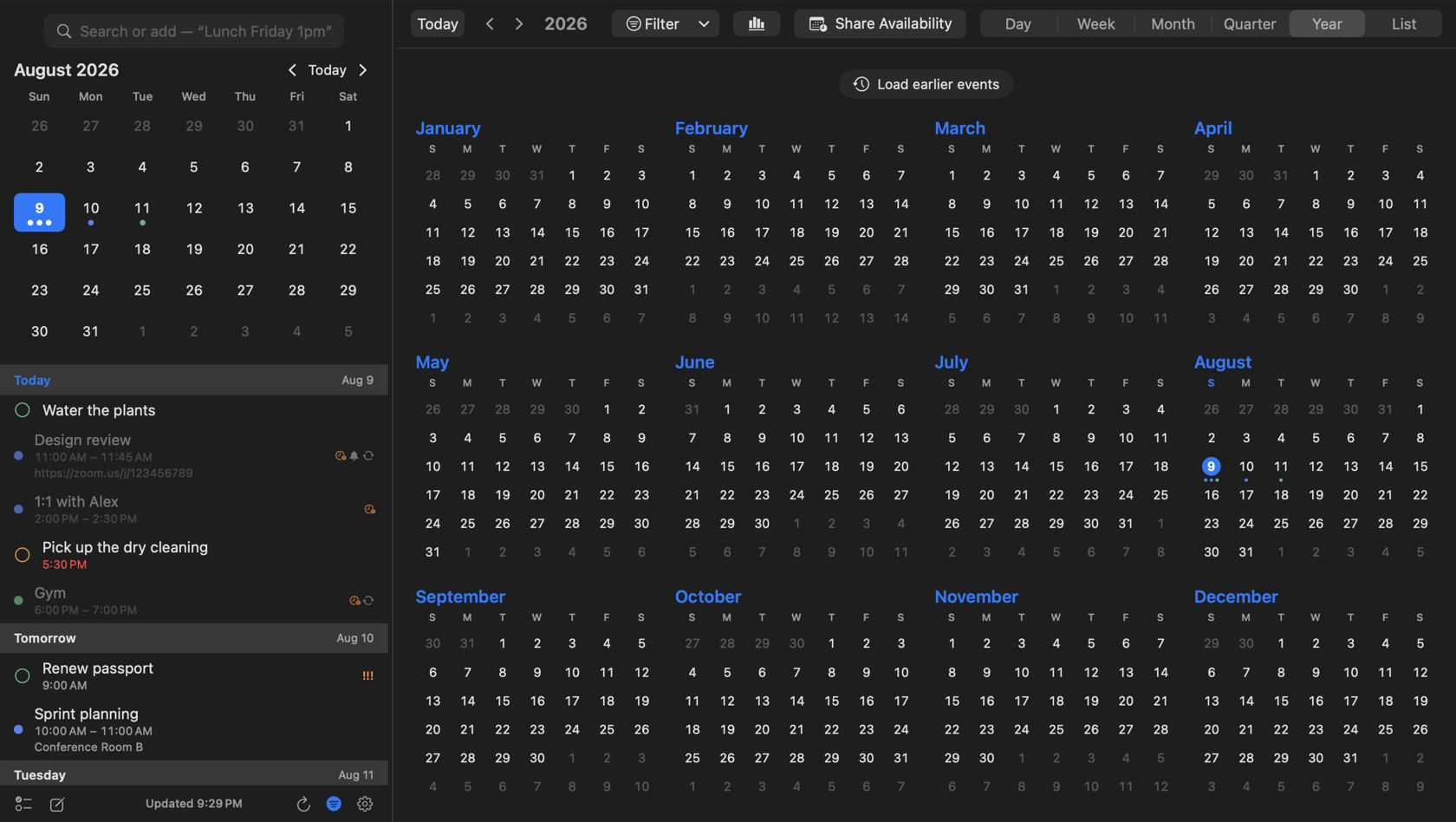
    Year view lays out all twelve months at once — the view you want in December when someone asks about March.

    InstaCal Year view showing all twelve months of 2026 at once beside the agenda
    The whole year, without leaving the calendar window.

    Your keys, your shortcutsMac

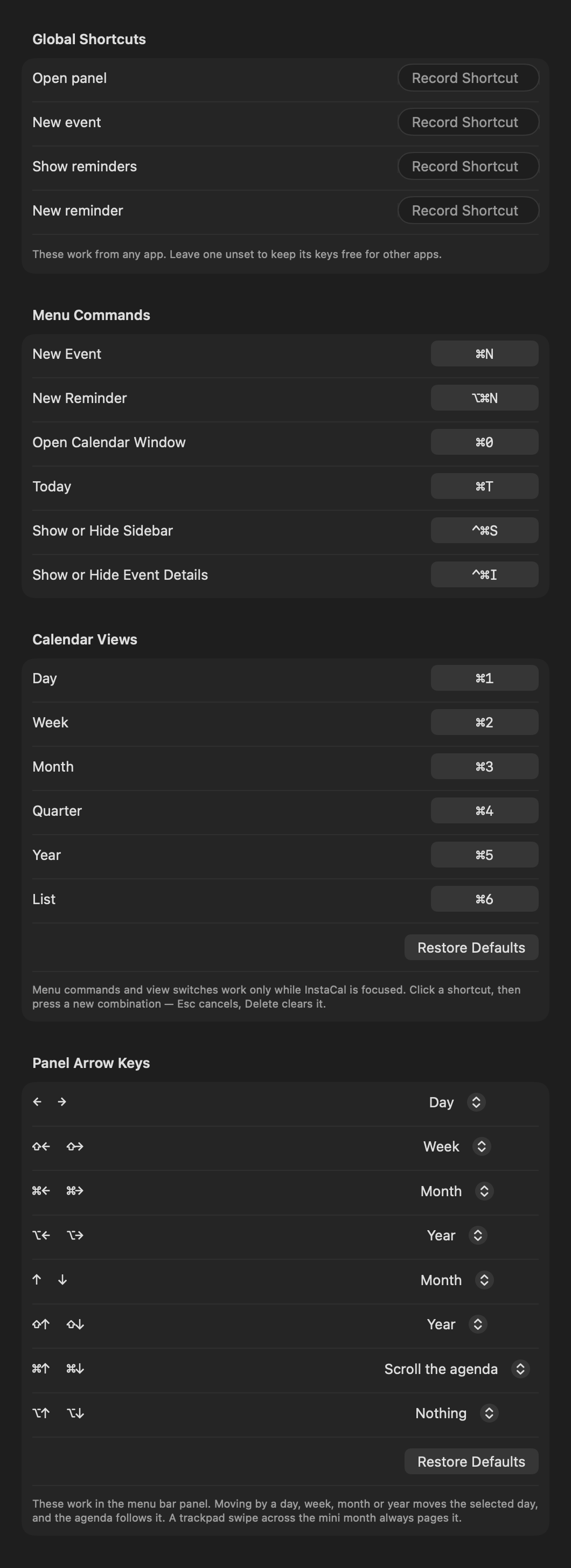
    Every menu command and calendar view takes a shortcut key you choose, including new ones for the sidebar and the event details pane. A menu bar app lives or dies on how fast you can get in and out of it.

    Shortcut settings listing global shortcuts, menu commands, calendar views and configurable panel arrow keys
    A key for every command and every calendar view.

    Prefer the short version? See every line →

    Everything in this release

    • Year view lays out all twelve months at a glance
    • Every menu command and calendar view takes a shortcut key you choose
    • New shortcuts open and close the sidebar and event details
    InstaCal Year view showing all twelve months of 2026 at once beside the agenda
    The whole year, without leaving the calendar window.
  9. Mac

    Invitations

    Invite people by typing a name, see conflicts before you reply, and answer Yes, Maybe or No without leaving the panel.

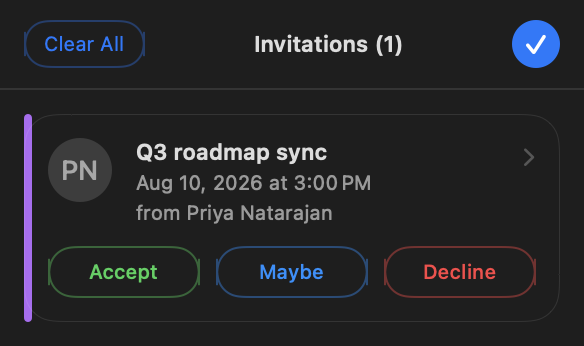
    Invitations became a two-way thing. Start typing a name or an email and pick from your contacts, photo and all — inviting someone is now a few keystrokes rather than a trip to another app.

    Coming the other way, an invitation tells you what it collides with before you answer it, which is the question you actually have, and you reply Yes, Maybe or No right there in the panel. Pending invitations and active alerts now share one bell instead of competing for your attention.

    One quiet fix worth the release on its own: a meeting synced from two accounts appears once, not twice.

    The Invitations inbox showing a Q3 roadmap sync from Priya Natarajan with Accept, Maybe and Decline buttons
    The conflict and the answer stay in the panel.

    Prefer the short version? See every line →

    Everything in this release

    • Invite people in a flash — start typing a name or email and pick from your contacts, photo and all
    • Invitations flag conflicts with your existing events before you reply
    • Reply to invitations with Yes, Maybe, or No right from the panel
    • Pending invitations and active alerts share a single bell
    • The same meeting synced from two accounts now appears only once
    The Invitations inbox showing a Q3 roadmap sync from Priya Natarajan with Accept, Maybe and Decline buttons
    The conflict and the answer stay in the panel.
  10. Mac

    InstaCal 3

    A rebuilt menu bar calendar: new design throughout, plain-English event entry, one-click joining for every meeting service, and your next event counting down in the menu bar.

    Version 3 is not an update to InstaCal so much as a second one.

    The whole app was redrawn. Full Dark Mode, themes, a panel you can resize — and a proper calendar window behind it with Day, Week, Month and List views, which the menu bar alone could never give you.

    The two additions that change the daily rhythm are smaller than that. Type what you mean — "Lunch with Sam Friday 1pm" — and watch the event assemble in a live preview before you commit it. And one-click Join for Zoom, Google Meet, Teams and twenty-odd other services, so the thirty seconds you spend hunting for the link in a calendar note stop happening.

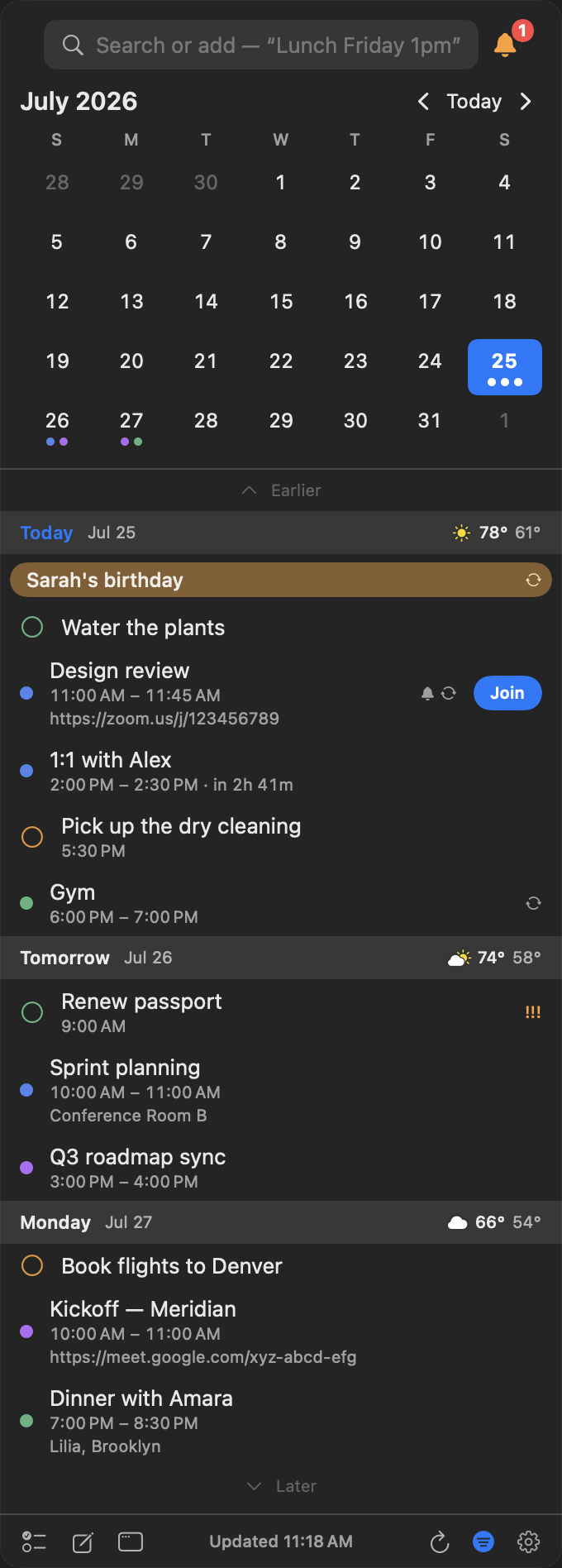
    Your next event and a live countdown sit in the menu bar, and Calendar Sets let you swap between groups of calendars in a click — work in the morning, everything at the weekend.

    The InstaCal panel in dark mode, showing the agenda under a month grid
    The redesigned panel — resizable, themed, dark mode throughout.

    Prefer the short version? See every line →

    Everything in this release

    InstaCal 3.0 is a complete rewrite — a new, faster InstaCal built from the ground up for modern Macs.

    Your accounts and settings carry over automatically.

    • All-new design with full Dark Mode, themes, and a resizable panel
    • Type events in plain English — “Lunch with Sam Friday 1pm” — with a live preview
    • One-click Join for Zoom, Google Meet, Teams, and 20+ meeting services
    • Your next event and a live countdown in the menu bar
    • Calendar Sets — switch between groups of calendars in one click
    • Full calendar window with Day, Week, Month, and List views
    • Search, week numbers, custom colors, and keyboard shortcuts throughout
    • Faster sync for Google and Microsoft 365, native on Apple Silicon
    The InstaCal panel in dark mode, showing the agenda under a month grid
    The redesigned panel — resizable, themed, dark mode throughout.
InstaCal app icon
Get the latest version $29.99 $19.99 once. One purchase includes InstaCal for Mac, iPhone, iPad and Apple Watch. No subscription, InstaCal account or ads.

Looking for how a feature works rather than when it arrived? The User Guide documents every workflow and setting.